

I see the same slide in almost every faith-tech pitch deck.
There are roughly 373,000 churches in America. Multiply by your price. The total usually has a B in it.
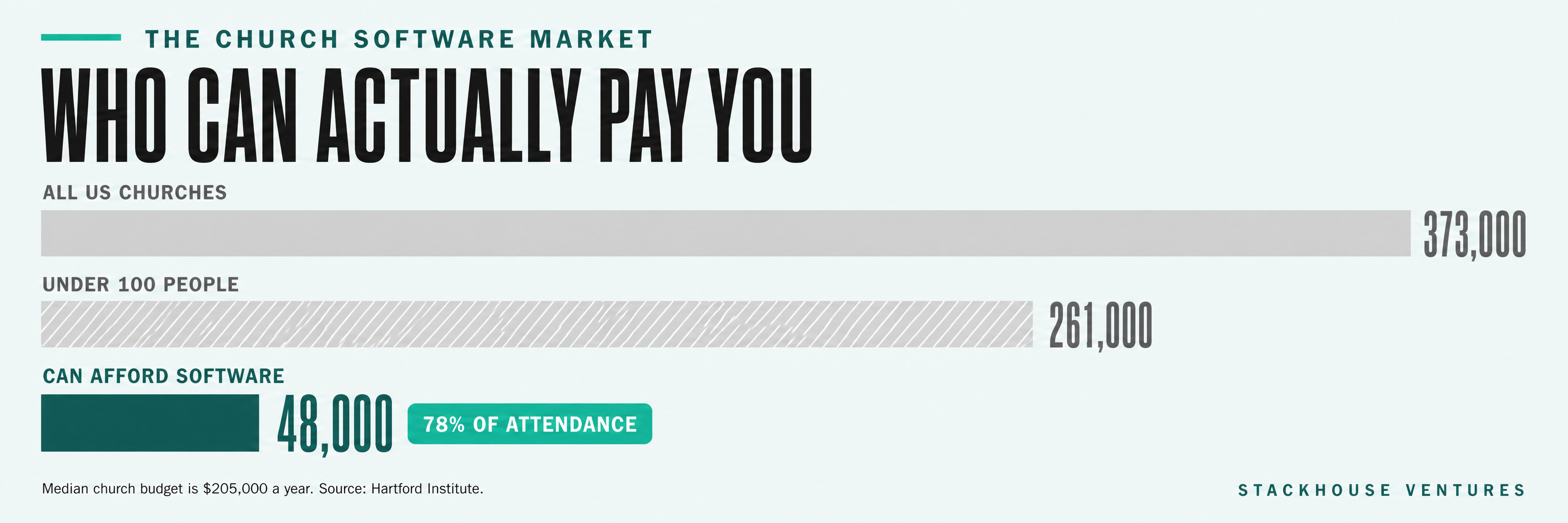
Most of those 373,000 churches will never buy software from anybody. They don't have the money. The number that can actually pay you is closer to 48,000.
The Math Nobody Runs
Hartford Institute counts about 373,000 congregations in the country. 70% of them have 100 people or fewer. Add all those small churches together and they make up 14% of everyone who attends church in America.
The median church runs on $205,000 a year, all in. That pays a part-time bookkeeper and a worship leader. It isn't buying your $400 a month platform this year, and it won't next year either.
Now the big end. The largest 13% of churches, the ones over 250 people, hold 78% of all churchgoers. That works out to about 48,000 churches. They have most of the paid staff and nearly all of the software budget.
Most faith-tech sales plans get built on the 373,000. But the deals those teams actually work are all inside the 48,000, and nobody goes back and fixes the plan.
What The Data Says About Narrowing
Everybody repeats that software built for one industry keeps customers better than software built for everybody. I believed it too. When I went looking for that in the benchmark data, I couldn't find it.
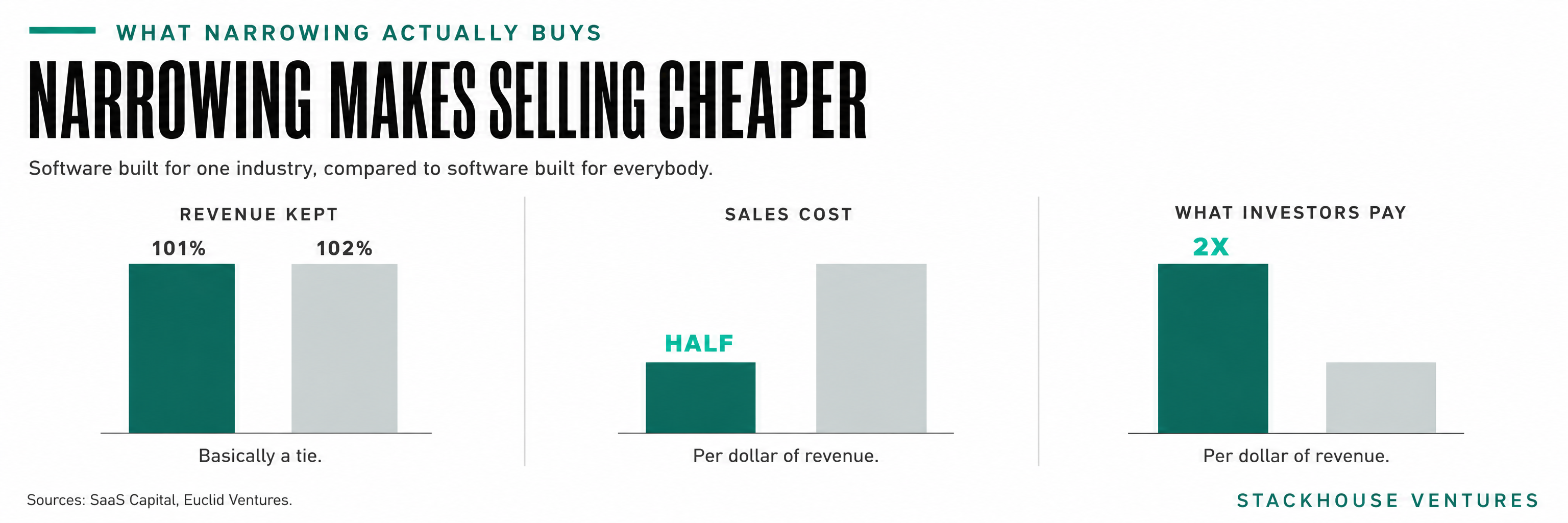
SaaS Capital surveys more than 1,500 private software companies. In 2023 they split the results into companies that serve one industry and companies that serve everybody. The one-industry companies kept 101% of their revenue year over year. The everybody companies kept 102%. They called the difference "only minor, and mixed."
Then in 2025 they went further. Across more than 1,000 companies, they said their own earlier finding that one-industry companies grow faster "has broken down." Median growth in 2024 was 25% and 24%.
So if you narrowed your market figuring customers would stick around longer, you probably didn't get that.
The advantage shows up somewhere else.
Euclid Ventures compared 36 public one-industry software companies against 60 that sell broadly. Retention was almost identical. The difference was cost. The one-industry companies spent half as much on sales and marketing for every dollar of revenue they brought in.
Investors notice. Public companies that serve one industry are worth roughly twice as much per dollar of revenue as the ones that serve everybody.
That advantage is biggest at companies under $100M in revenue, which means it's biggest for everyone reading this. The tradeoff is margin. Serving one industry means doing more of that industry's specific work, so gross margins run about 65% against 75%. You save money on sales and spend some of it back on service.
So a tight niche makes it cheap to find and win customers while you're small. That's less than what people usually claim for it, and it's what the numbers actually back up.
5 Tests For Picking Which Churches To Sell To
Can You Name The Churches?
"Churches" is a category. A niche is something you can put in a spreadsheet.
Like this: multisite churches between 800 and 5,000 people, running Planning Center, who hired an operations director in the last 18 months. Somebody on your team can go build that list this week.
Paul Graham put it plainly: "It's always worth asking if there's a subset of the market in which you can get a critical mass of users quickly."
If nobody on your team can build the list, you don't have a target yet.
Is The Segment The Right Size?
A segment has to be big enough to be worth winning and small enough that you can actually win it. Most founders only check one of those.
Geoffrey Moore, who wrote Crossing the Chasm, said big enough means a path to about $100M in revenue inside 5 years. That's a venture-scale number and it isn't the one I use. At Stackhouse we look for a clear path to $500K in recurring revenue within 3 years. Pick whichever number fits the company you're actually building.
Then check the other half. Count the real churches in the segment, use a price you'd actually charge, and ask whether you could become the obvious choice in that group.
Can They Pay, And Does Somebody There Own A Budget?
This is where 373,000 turns into 48,000.
Peter Thiel's line in Zero to One gets quoted constantly: "every startup should start with a very small market. Always err on the side of starting too small."
The part people skip is that a small market still has to be a market. The churches in it need money and somebody with the authority to spend it. If your buyers love you and can't pay you, none of the rest of this matters.
Jason Lemkin built EchoSign, sold it to Adobe, and now runs SaaStr, the largest community of software founders. He's been making the same point for years: what kills niche companies is usually pricing, because they charge too little. His fix is to build the thing that runs the customer's core operation, then charge like it.
Is Your Sales Cost Dropping As You Add Customers?
If narrowing is working, your 20th customer in a segment costs less to get than your 5th. Referrals show up without you asking. Sales calls get shorter because you've heard the objections before. Onboarding speeds up because the setups repeat.
Track your cost per customer one segment at a time. The blended number hides all of this. If the cost is flat across your first 20 customers in a niche, you've got a list, and the whole reason for narrowing never showed up.
Superhuman is the cleanest example. Rahul Vohra asked his users how they'd feel if they could no longer use the product. Then he stopped building for everyone and built only for the group who said they'd be very disappointed. That group went from 22% of his users to 32%, then to 58% over 3 quarters. The market never changed. He got specific about who the customer was.
Do You Know Which Segment Comes Next?
Say your niche is 400 churches and you win 60 of them. That's a real business, and you're running out of room. So you win one segment, then move to the one next door that shares a customer you can reference or a channel you already use.
Pushpay is worth studying here because you know the company. They started in 2011 doing one thing, mobile giving for churches. In 2019 they bought Church Community Builder for $87.5 million to add church management, then bundled everything together the year after. Revenue reached $202.8 million in their 2022 fiscal year, up 13%. The next year they guided growth down to 5 or 6% and guided profit down with it. They were taken private in 2023.
Buying your way into the next segment is a real option and it gave Pushpay scale. Their growth kept slowing anyway.
Pick the next segment before you need it. Write down which group shares a buyer, a conference, or a denominational network with the one you're in now.
What This Looked Like At The Start
Planning Center is the one everybody in this market knows. Jeff Berg and Aaron Stewart started it in 2006, and both of them were on church staff in Southern California at the time. Berg was rebuilding spreadsheets every week and retyping run times every time the order of service changed.
So the first version did one thing. In his words, "The first version was just a drag-and-drop order of service with timing. It was simple, but it solved our problem."
One screen, one job, for one person at one kind of church.
Twenty years on they've never taken outside money, they employ more than 200 people, and Planning Center Giving processes over $600 million in donations a month. Berg's explanation of how they got there is worth writing down: "In order to have a good yes, you have to have a whole bunch of hard no's as well."
Saying no is the hard part, and it never feels strategic while you're doing it. It feels like turning down money you need.
Worth knowing that Planning Center told people for years they would never build a church management system. Eventually they built one. That's the next segment showing up, and it took them a long time to get there.
Your Assignment This Week
Sort your customer list by segment. Define each one tightly enough that you could name the other churches in it.
Then answer 3 questions for every segment:
- What did your last 3 customers there cost you to acquire?
- How many of them came from a referral you didn't ask for?
- How long did it take from first conversation to signature?
One of them is going to look better than the others on all three. That's where you focus, and you probably already knew which one it was.
Then look at your roadmap and count how much of it serves that segment. If it's under half, you know what next quarter is for.
If you want to be in a room with founders who have already worked through this, including the ones who got it wrong the first time, that's what the Builder Conference is. Jackson Hole, this November.
So which one is it for you?
Sources and Further Reading
- Faith Communities Today, Hartford Institute for Religion Research. Where the 373,000 and the church size bands come from.
- Religion News Service on the 2025 congregational survey. The $205,000 median church budget, plus the first attendance gain in 25 years.
- SaaS Capital 2023 retention benchmarks and 2025 growth benchmarks. The best free benchmark data for private software companies at our size.
- Euclid Ventures, The Vertical SaaS Profit Premium. The clearest analysis of where the one-industry advantage actually lives.
- Paul Graham, Do Things that Don't Scale. Still the best 15 minutes a founder can spend.
- First Round Review on Superhuman. The survey method Rahul Vohra used, written out step by step so you can copy it.
- Planning Center's founders on 20 years. Worth reading whether or not you compete with them.
- Peter Thiel, Zero to One, chapter 5. The small markets argument in its original form.