
I talked to a founder this week who has already built something real. A working platform, paying customers, a growing footprint inside a niche he understands well. The kind of traction most founders spend years chasing.
He also had several new directions he wanted to pursue at once, each one aimed at a different kind of customer, each one requiring its own channel and its own way of building trust. Each idea, taken alone, looked defensible. He was already assembling several different companies before he had proven he could scale a single one.
The oversupply problem
This is the pattern I see most often with founders who stall somewhere between six figures and seven. It is rarely a shortage of ideas. It is an oversupply of good ones.
A bad idea dies on its own. Nobody defends the version of the product nobody wants. The real problem shows up with the ideas that actually work, because a good idea gets a seat at the table and never leaves. Each one takes a slice of attention, a slice of engineering time, a slice of the founder's own belief in what the company is actually for. Add up enough of them, and that oversupply becomes the reason growth stalls.
The Rule of Five Ones
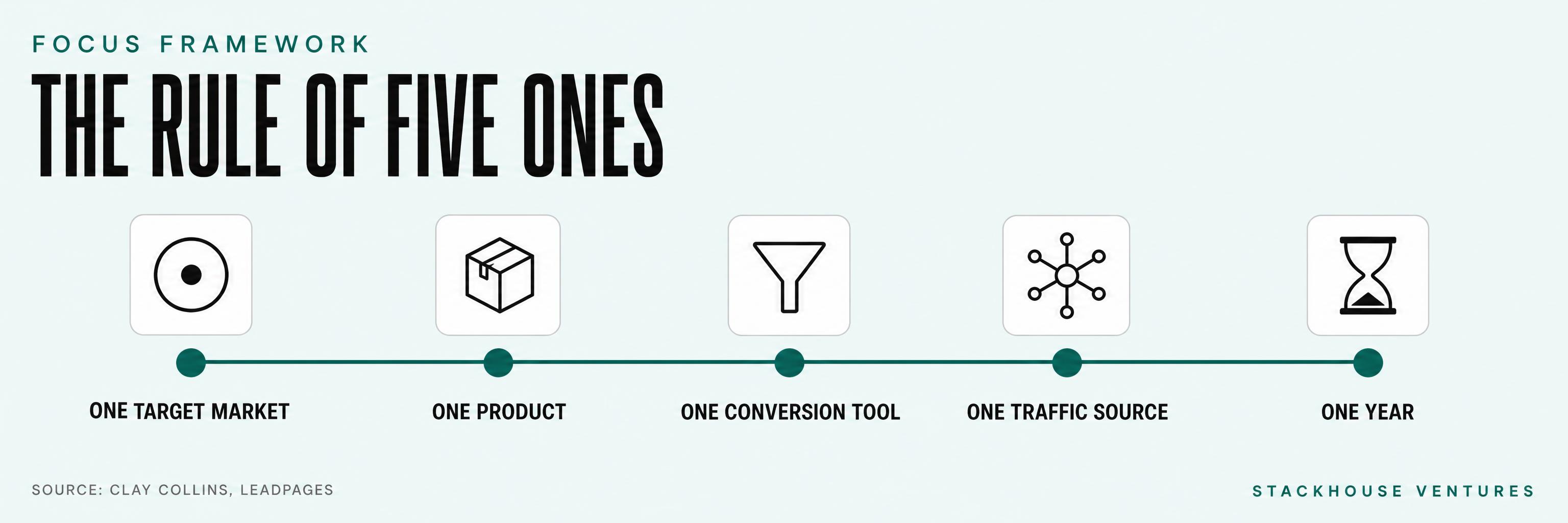
The framework I keep coming back to when I talk to founders in this spot traces back to Clay Collins, the founder of LeadPages, who calls it the Rule of Five Ones.
To get to $1 million in annual recurring revenue, line up one target market, one product, one conversion tool, one traffic source, and one year of full commitment to all four. Everything outside that list is a tax on the one thing that could actually work.
The founder I was talking to did not disagree with any of this in principle. He agreed his core business had already proven itself, and that the newer directions were unproven and worth testing carefully before committing to any of them. What he would not do was shut the core business down while he tested them.
That reluctance is the real signal. Keeping the original business alive as a hedge feels responsible. It also means full focus on the new direction hasn't actually happened yet. Leaving two doors open is the surest path to mediocrity, because real focus never gets the chance to prove itself.
This is exactly the kind of thing we screen for at Stackhouse Ventures before we invest. A founder who has proven one channel to one audience, even a smaller one, is a stronger signal to us than a founder holding several plausible directions at once. Founders who close most of their options and commit hard to the one that's left are the ones who actually scale.
The founder I spoke with has a real business. What he does next with the ideas sitting in front of him will decide whether it becomes a bigger one or a permanently comfortable one. My advice to him, and to every founder we talk to at a similar stage, is the same: pick the one path that has already proven it works, give it every resource you have for a full year, and treat every other good idea as something to revisit only after that one has scaled.
Distraction rarely introduces itself as distraction. It shows up wearing the same clothes as opportunity.