
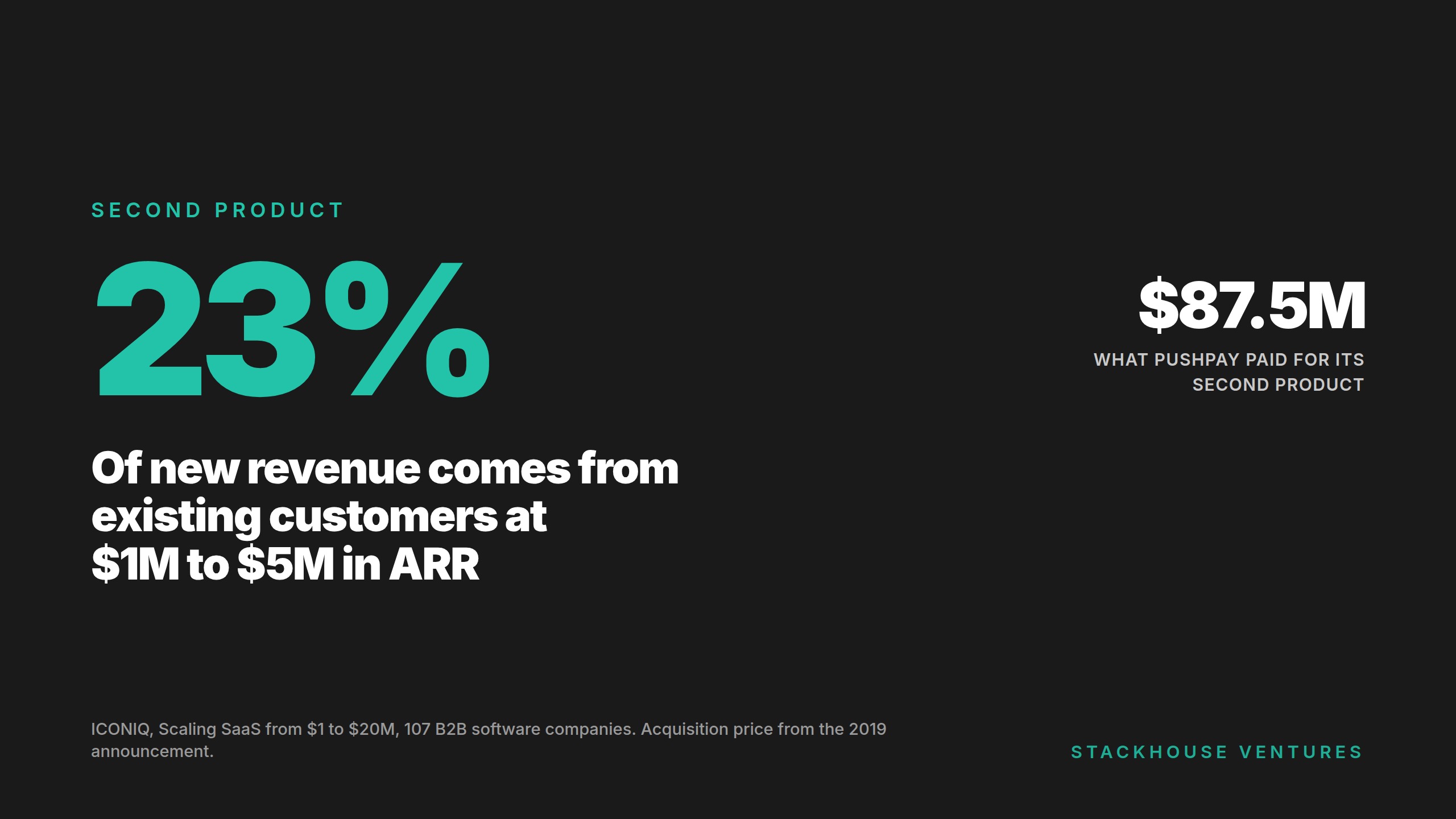
Somebody has told you the real money is in the second product.
They're describing a company much larger than yours, and the expansion data shows you exactly where the line sits.
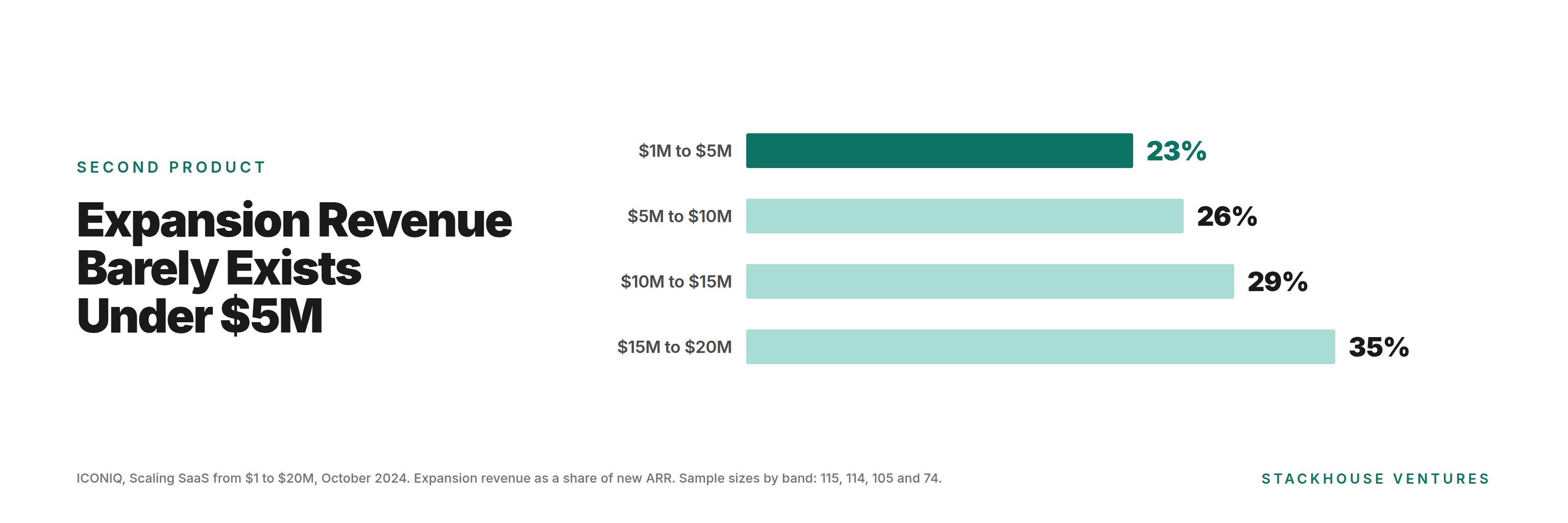
Expansion Revenue Barely Exists Under $5 Million
ICONIQ is an investment firm that publishes operating benchmarks drawn from its portfolio. They analyzed financial data for 107 B2B software companies and broke expansion revenue out by revenue band. This is one of the few benchmark sets that goes below $20 million, which makes it unusually useful here.
Expansion revenue as a share of new ARR runs 23% at $1 million to $5 million, 26% at $5 million to $10 million, 29% at $10 million to $15 million, and 35% at $15 million to $20 million. Sample sizes by band are 115, 114, 105 and 74.
Their own summary of the pattern: expansion contributes meaningfully to growth "once a healthy new logo base has been established and retained."
At $1 million to $5 million, roughly 75% of your new revenue still comes from new customers. The expansion engine that makes a second product pay for itself doesn't exist yet at your size.
Higher up, it does. Benchmarkit puts expansion at 40% of total new ARR across its 583-company sample, and 58% for companies at $50 million to $100 million. High Alpha is a venture studio that runs an annual software benchmark survey, and their 800-plus respondents puts companies above $50 million at roughly 60% of new ARR from existing customers.
The pattern is consistent across 3 independent datasets. Second products pay off in businesses that already have a large, retained customer base to sell into.
What The Operators Say
Kyle Poyar, who spent years at OpenView Partners and now writes the Growth Unhinged newsletter, names the conventional threshold and then qualifies it: "Historically the rule of thumb has been to wait until you're $20-50M ARR before going multi-product. I suspect this ARR threshold is dropping and will continue to drop with AI."
Jason Lemkin built EchoSign, sold it to Adobe in 2011, and now runs SaaStr, the largest community of B2B software founders. His range is wider than Poyar's and his test is better. He puts it at "Sometimes by as early as $20m ARR, sometimes by as late as $200m ARR, or later", and defines a real second product as "a true stand-alone, second purchase" serving "a market at least as large as the first product."
He also names the trigger that actually forces the decision: once you cross 3,500 customers, and certainly by 10,000, you start saturating most B2B markets.
That's the real signal. A second product is what you build when you're running out of first-product customers, and almost nobody at $800,000 is running out.
What Nobody Has Published About Second Products
Nobody publishes benchmark research segmented by product count. I checked ICONIQ, Bessemer, Benchmarkit and High Alpha.
So there is no published answer to "what share of revenue comes from product 2" or "do multi-product companies retain better." Any article that gives you those numbers made them up.
There is also no credible research on how often second products fail at small companies. The "90% of products fail" numbers in circulation trace to nothing.
What exists is expansion data by company size, operator opinion from people who have done it, and one public company in this exact market whose numbers you can read.
5 Tests Before You Build Or Buy A Second Product
Have You Run Out Of First-Product Customers?
Count the churches in your segment that fit your product, then count how many you have.
If you've got 60 customers in a segment of 4,000, you haven't run out of anything. You have a distribution problem, and a second product won't fix it.
Lemkin's saturation point is 3,500 customers. Bessemer's guidance on scaling to $1 million is about getting the first product working. Nothing in any of this says build product 2 at $800,000.
Is Expansion Revenue Already Working?
If your existing customers aren't buying more of what you already have, they won't buy a second thing either.
Compute it. Of the new revenue you added last year, what share came from customers you already had? If you're under the 23% median for your band, your problem is inside the current product.
The most common version of this is a company with one price and no upgrade path, where every customer pays the same $99 forever. That company needs a second tier, and it can build one this quarter.
Would You Sell It To Somebody Who Does Not Buy Product 1?
This is Lemkin's test and it is the sharpest one available. A real second product is a stand-alone purchase into a market at least as large as your first.
If the answer is "our existing customers would like it," you're describing a feature. Ship it inside the product and raise the price.
Features you can charge more for are how you get to the expansion revenue in test 2. That is a much better use of 6 months than a second product nobody outside your customer list would buy.
Can You Fund It Without Slowing Product 1?
SaaS Capital puts R&D at 24% of revenue for companies at $3 million to $5 million in ARR, from a survey of more than 1,000 private companies.
At $800,000 in revenue, a proportional R&D budget is about $192,000, or a little over one engineer. A second product built on that budget means product 1 gets nothing for 2 quarters while a competitor with one focus keeps shipping.
The version that works is a second product sharing your infrastructure, sold to the same buyer, built in weeks. The version that kills small companies takes its own engineers, its own sales motion, and its own support, which means you are now running 2 companies on one payroll.
Look At What Happened To Pushpay
This is the only company in the church software market with an audited public record, and the record is worth reading before you copy the strategy.
Pushpay bought Church Community Builder in December 2019 for $87.5 million in cash, funded partly with $62.5 million of senior secured debt. CCB brought over 4,000 customers.
The trajectory afterward, from their own filings:
- FY2020 revenue rose 33% to $127.5 million, with CCB contributing about $4.4 million over 3 and a half months of ownership
- FY2022 revenue rose 13% to $202.8 million, with the customer base up to 14,508
- FY2023 guidance came in at 10 to 15% growth
- The company agreed to a take-private at NZ$1.42 a share in March 2023, implying about US$1,015 million
Growth went from 33% to 13% with the second product fully in the base. Their stated strategy names "increasing the number of Products utilised" as a growth driver, and across 3 years of announcements they never once disclosed a cross-sell attach rate or a products-per-customer number.
Buying a second product got Pushpay scale and a billion-dollar outcome. It didn't reaccelerate growth. Both of those are true, and you should plan for both.
What A Working Second Product Looks Like
ServiceTitan is the cleanest public example of a vertical software company where the second line actually carries weight.
Their fiscal 2026 results show total revenue of $961.0 million, up 24%, with subscription revenue of $712.3 million and usage revenue of $213.1 million. Net dollar retention over 110%, gross dollar retention over 95%, roughly 10,800 active customers.
Usage revenue is 22.2% of the total. That's my arithmetic on their disclosure, since they don't publish the percentage themselves.
Note what had to be true first. About 10,800 customers, retention above 95%, and a payments product riding on transactions their customers were already running. The second product attached to something the first one was already doing.
That's the shape worth copying, and it arrives a long way past $1 million.
Your Assignment This Week
Answer 4 questions before you write a line of code for anything new.
- How many churches in your target segment fit your current product, and how many have you sold?
- What share of last year's new revenue came from existing customers?
- What would you charge for the best feature you could add to product 1, and how many customers would pay it?
- If you built the second product, who buys it who does not already buy product 1?
If the answer to question 4 is nobody, you've got a feature. Price it, ship it, and come back to this in 3 years.
If you want to be in a room with founders who have added a second product, including the ones who wish they had waited, that is what the Builder Conference is. Jackson Hole, this November.
How many customers are left in your first market?
Sources and Further Reading
- ICONIQ, Scaling SaaS from $1 to $20M, October 2024. 107 companies. The expansion-by-revenue-band chart is the most useful thing published for founders at this size.
- Benchmarkit, 2025 B2B SaaS Performance Metrics Benchmarks, May 2025. Expansion at 40% of total new ARR across 583 companies.
- High Alpha, 2025 SaaS Benchmarks. More than 800 respondents.
- Kyle Poyar, The compounding startup, November 2025. The $20 to $50 million threshold, which he presents as a rule of thumb and not as a finding.
- Jason Lemkin, Fake Multi-Product vs. Real Multi-Product, April 2025. The stand-alone purchase test and the customer saturation point.
- Pushpay and Church Community Builder combination announcement, December 2019, plus the FY2020 and FY2022 NZX results and the revised scheme price, March 2023.
- ServiceTitan fiscal 2026 results, March 2026. A vertical software company where the second revenue line is 22% of the total.
- SaaS Capital, 2026 Spending Benchmarks, June 2026. R&D as a share of revenue by company size.