
Wes Bush wrote the book on product-led growth and runs ProductLed, and his line on small markets is the shortest useful thing anybody has published on this: "If you have a niche product with a total addressable market (TAM) of 50 customers, good luck. A freemium model will give away your product to the precious few users who might actually pay for it."
Your market is bigger than 50. It isn't bigger by enough.
The Conversion Numbers For 2026
Kyle Poyar spent years at OpenView Partners and now publishes the Growth Unhinged newsletter. In January he surveyed 200 software products with ChartMogul, the subscription analytics platform, and ProductLed. The median free-to-paid conversion rate came in at 8%.
Read the definition before you use that number, because it's looser than it looks. The survey asked for the percentage of "leads or free signups" converting within 6 months, and mixing marketing leads into the denominator means different respondents answered different questions. It is also self-reported by founders about their own products, which biases high.
The respondent profile does match you, though, better than most benchmark surveys. 34% were under $1 million in ARR and another 29% between $1 million and $5 million.
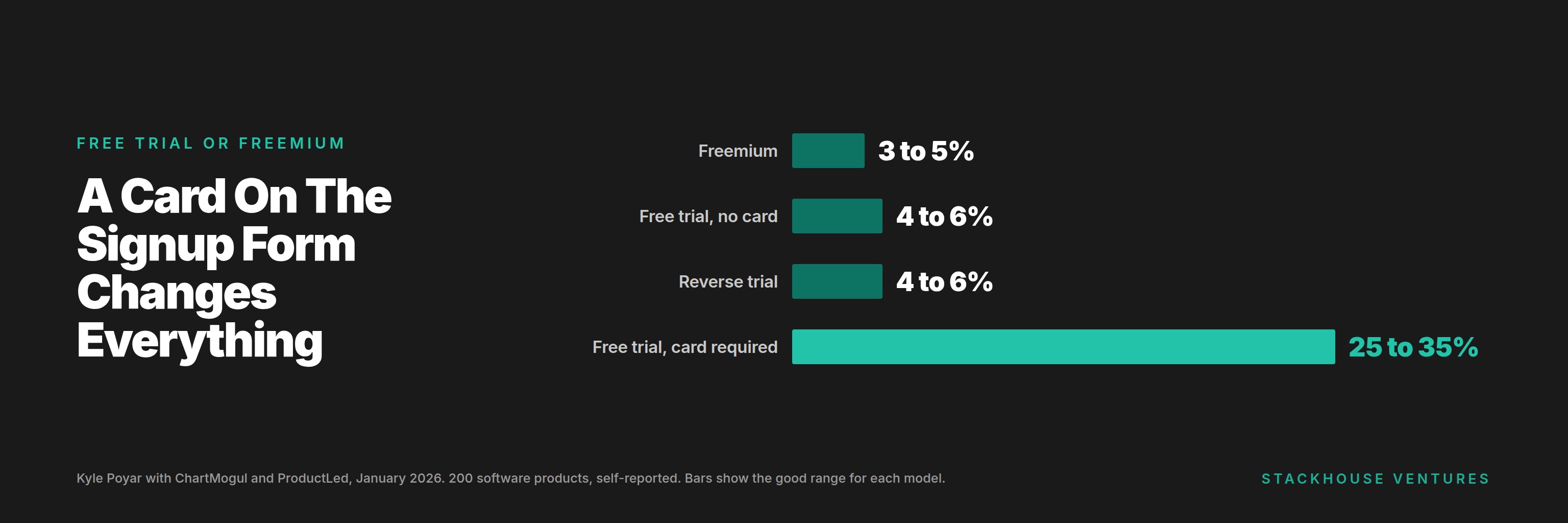
The model comparison is where this gets useful:
| Model | Good | Great |
|---|---|---|
| Freemium | 3 to 5% | 8 to 12% |
| Free trial, no credit card | 4 to 6% | 10 to 15% |
| Reverse trial | 4 to 6% | 8 to 12% |
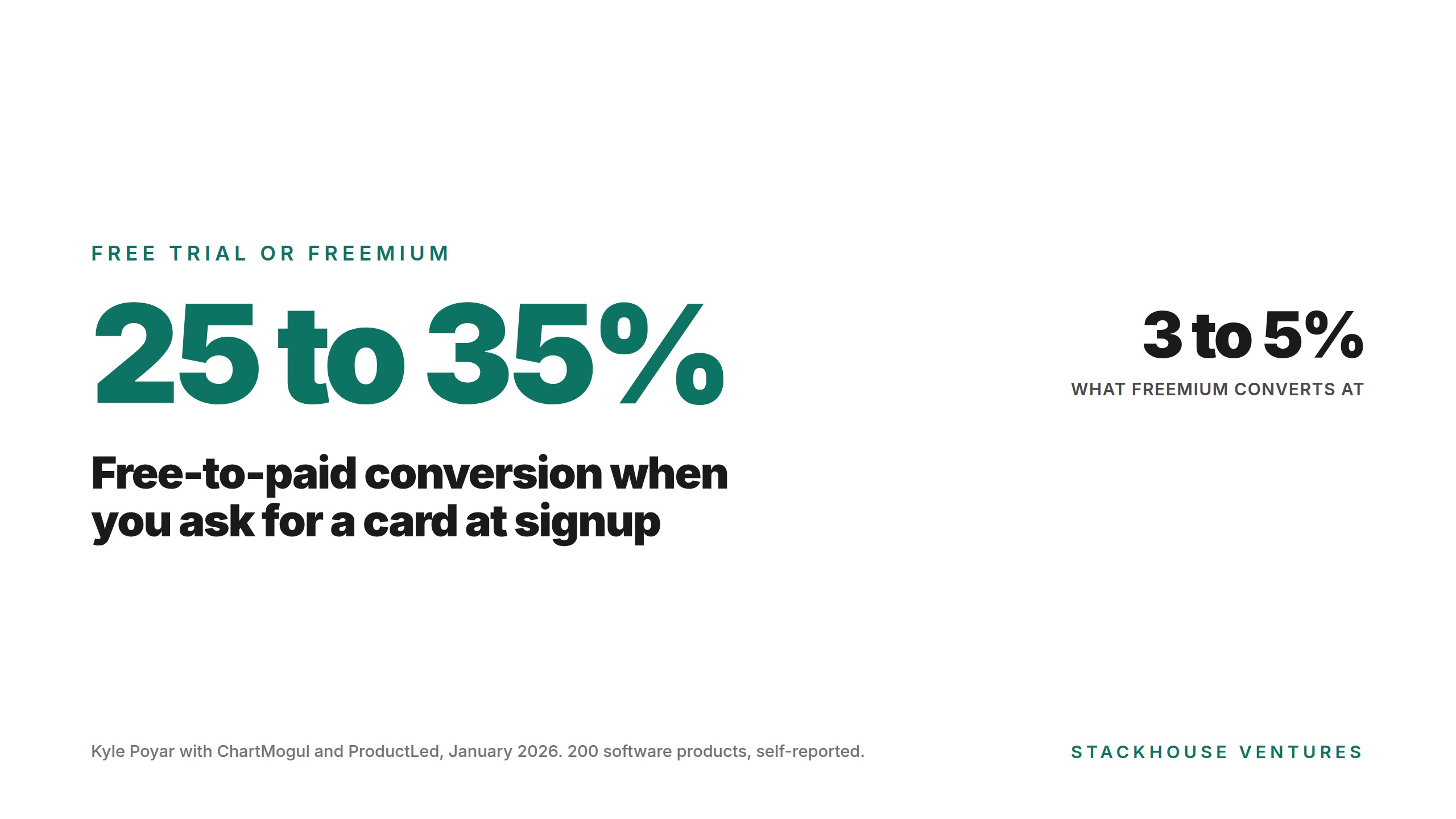
| Free trial, credit card required | 25 to 35% | 50 to 60% |
That last row isn't a typo. Requiring a card at signup moves conversion by roughly 5 times.
RevenueCat sees the same shape in observed billing data, which is a much better instrument than a survey. Across more than 115,000 apps representing over $16 billion in revenue, a hard paywall converts at a 10.7% median while freemium converts at 2.1%. That's mobile consumer subscription data, so treat it as directional evidence that the difference is real, and not as a B2B benchmark.
Across those 200 products, 57% run a free trial and 26% run freemium. Within the free trials, only 20% require a card.
Run The Math At Your Own Price
Jason Lemkin built EchoSign, sold it to Adobe in 2011, and now runs SaaStr, the largest community of B2B software founders. He published the clearest version of why freemium needs scale. His model: to reach $100 million in ARR at $10 a month, you need a million paying customers, and at a 2% conversion rate that means 50 million active users.
Lemkin is doing back-of-envelope arithmetic here, and it runs entirely on a consumer price point. So run it at yours.
Say you charge $1,200 a year and want to reach $2 million in revenue. That is 1,667 paying churches. At a 3% freemium conversion rate you need about 55,000 free accounts.
There are roughly 48,000 churches in America that can afford software at all. You'd need more free accounts than there are qualified buyers in the country.
At a 30% conversion rate with a card on file, the same $2 million needs about 5,600 signups. That's a hard number, and it's a reachable one.
How Much To Trust These Conversion Numbers
The 8% median comes from 200 self-reported products answering a loosely worded question. The good and great bands come from the same survey.
Nobody has published free-to-paid conversion benchmarks segmented by market size, which is the exact cut that would answer this question properly.
And Wes Bush's 50-customer line is an argument. It's a good one, and it's still an argument.
What I trust here is the direction and the size of the difference between gated and ungated free offers. It shows up in a founder survey and in observed billing data from 2 completely different populations, which is about as much corroboration as this subject ever gets.
5 Rules For Offering Something Free In A Small Market
Put A Card On The Signup Form
This is the biggest single improvement available to you, and it takes an afternoon.
The conversion difference between a card-required trial and an ungated one is roughly 5 times in the survey data and roughly 5 times in RevenueCat's observed data. A card doesn't stop a serious buyer. It stops the browsing.
In a market of 48,000 possible customers, you don't need volume at the top of the funnel. You need to know which 200 of them are actually shopping right now.
Use Free To Start Sales Conversations
Lemkin names this as one of the ways freemium still works for a company that isn't consumer-scale. You use free as a funnel into a sales conversation. His example is HubSpot acquiring users who later pay $10,000 to $100,000 a year.
That reframe matters at your size. A free tier producing 400 email addresses you actually call is doing its job. A free tier meant to convert on its own, with nobody talking to anybody, needs volume you'll never have.
Give Them The Whole Product For 30 Days
Feature-limited free tiers in a small market create a permanent population of users who have what they need and will never pay. In a market of 373,000 congregations where most have no full-time staff, that population is enormous and none of it is revenue.
A 30-day window with the whole product creates a decision date. Somebody has to act, and you find out which way inside a month.
If you want the freemium feel without the permanent free rider, a reverse trial does that: full product for a window, then it drops to a limited free tier. The survey puts reverse trials at 4 to 6% good and 8 to 12% great, which is better than plain freemium and well short of a gated trial.
Count What Free Users Cost You
Nobody has published a credible per-user cost to serve free accounts. I looked, and every number I found was invented on a vendor blog.
What is published, from Poyar's May 2026 monetization survey of more than 230 companies: the median target gross margin for AI features is about 50%, and only 12% of companies aim for SaaS-like margins above 80%.
If your product has AI in it, every free user costs you something real, and your structural margin is half of classic software. Free stopped being free the moment you added inference to it.
Your support time is the other cost, and it's the one founders never count. Free users email you like paying ones do. At 40 paying customers and 300 free accounts, you can spend most of a week on people who'll never pay you anything.
Ask Whether A Demo Beats A Trial
Elena Verna has run growth at a string of software companies and writes about the conditions under which product-led growth breaks down. Her argument is about the product itself. Two of her conditions apply directly to church software. If users need someone from your team to reach activation, the self-serve loop breaks. If they cannot understand the value on their own, self-serve is close to impossible.
Church software usually needs data migrated, a directory imported, and somebody on staff trained. A pastor signing up alone on a Tuesday night isn't going to reach the moment where your product looks good.
The staffing data explains why. The National Congregations Study found 37.2% of congregations have no full-time staff, and the median congregation has exactly 1. Self-serve assumes somebody has a free afternoon to work your product out. In most churches, nobody does.
For most products in this market, a 20-minute call where you set up their real data will outperform any free trial. It converts better, it tells you what they need, and it costs you an hour you were going to spend on support anyway.
What The Big Players Actually Do
Set the general SaaS advice aside and look at what the companies in this market actually publish.
Planning Center gives People away free with unlimited records, and meters every other product on volume. Tithe.ly and Subsplash both run free giving tiers and make money on payment processing. Breeze charges $72 from the first day with no free tier at all.
Every one of those free offers has a revenue mechanism attached that fires without a conversion event, either processing fees or a paid product sitting next to the free one.
That's the pattern worth copying. Free works in this market when something else is already earning while the account sits there.
Your Assignment This Week
Pull your free accounts and answer 4 questions.
- How many free accounts do you have right now?
- How many of them converted to paid in the last 12 months?
- How many support emails did free accounts generate last quarter?
- What is your actual conversion rate, and how does it compare to the 3 to 5% freemium band?
If your conversion rate is under 3% and free users are generating support load, your free tier is costing you more than it brings in. Add a card requirement or a time limit, then watch what happens over the next 60 days.
If you want to be in a room with founders who have run both models in this market, that is what the Builder Conference is. Jackson Hole, this November.
How many of your paying customers started on your free tier?
Sources and Further Reading
- Kyle Poyar, The 2026 free-to-paid conversion report, February 2026. 200 products surveyed in January with ChartMogul and ProductLed. Read the definition of the metric before you use the median.
- Wes Bush, Free Trial vs Freemium. The MOAT framework, and the clearest published statement of why freemium fails in a constrained market.
- Jason Lemkin, on freemium and the 50 million user problem, January 2026. Run his arithmetic at your own price point.
- Elena Verna, Not All B2B Companies Should Be Doing Product-Led Growth, January 2023. The activation and self-serve-comprehension conditions are the ones that matter in this market.
- RevenueCat, State of Subscription Apps, March 2026. Observed billing data across more than 115,000 apps. Consumer mobile, so use it for direction.
- Kyle Poyar, The State of B2B Monetization in 2026, May 2026. More than 230 companies, including the AI gross margin finding.
- Kyle Poyar and Lenny Rachitsky, What is a good free-to-paid conversion rate, August 2023. More than 1,000 products, and the finding that products with more stakeholders convert at half the rate.