
I went looking for research on how founders at your size spend their week.
There isn't any.
There is a genuinely good academic literature on CEO time use, and every serious study in it samples companies 50 to 100 times bigger than yours. The best of them, published in the Journal of Political Economy, covers 1,114 CEOs across 6 countries, and the median firm in that sample has 300 employees and $35 million in sales.
The famous Harvard Business Review study tracked 27 CEOs of large companies for 13 weeks, starting in 2006.
Neither one has anything to say about a 4-person company at $800,000. Applying them to you is a category error, and I'd rather tell you that than dress up a big-company statistic as advice.
The Data That Does Cover You
SaaS Capital's 15th annual survey covers more than 1,000 private B2B software companies, completed this March.
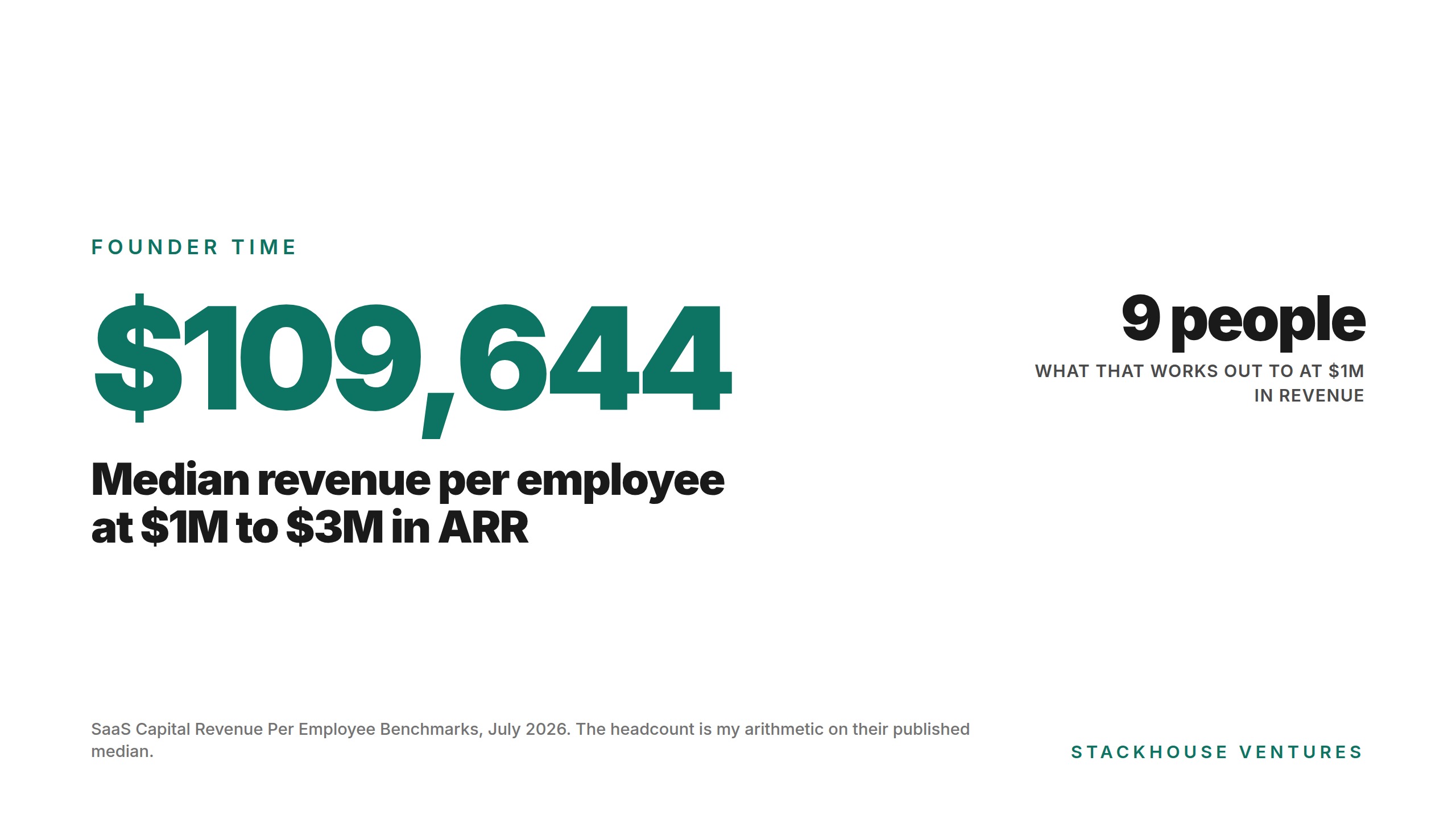
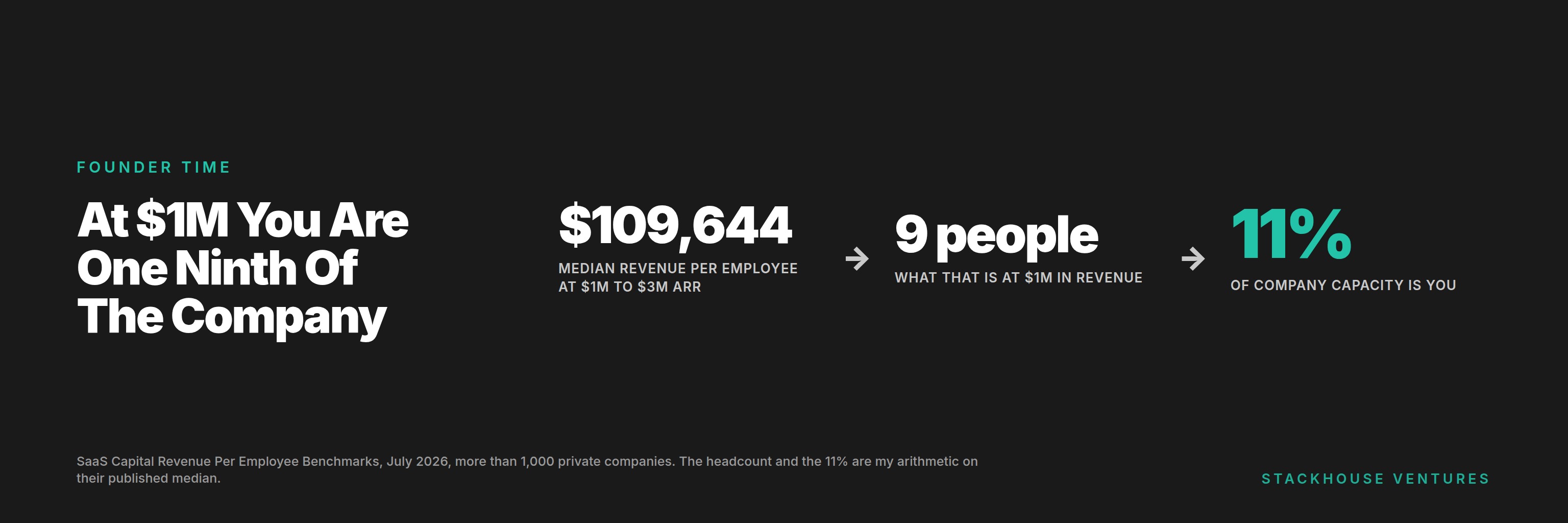
Companies at $1 million to $3 million in ARR show median revenue per employee of $109,644. The all-company median is $141,125, up from $129,724 the previous year.
Nobody publishes headcount by revenue band. What follows is my own arithmetic on their published median. At $109,644 per employee, a company at $1 million in ARR runs on about 9 people. At $3 million, about 27.
If you're at $800,000, you've probably got somewhere between 4 and 8 people including yourself.
At 9 people you're 11% of total company capacity. Every hour you spend on something somebody else could do costs the company a full point of its ability to do anything at all.
The bootstrapped companies run leaner still. At $5 million to $10 million in ARR, bootstrapped companies show $177,240 per employee against $152,295 for equity-backed companies at the same size.
Why Most Founder Statistics Are Worthless
Almost everything else in this area is unusable.
Every "founders work X hours a week" statistic I chased traced back to a vendor content page with no published method. The widely repeated founder burnout numbers mostly come from one survey of 400-plus founders whose methodology is not published anywhere.
The one peer-reviewed finding worth knowing is real, and much narrower than the version people quote it as. A study in Small Business Economics comparing 242 entrepreneurs against 93 comparison participants found entrepreneurs self-reported more depression, ADHD, substance use and bipolar disorder than the comparison group. That's self-report. Nobody in the study was clinically diagnosed, and the comparison group is small. Read it carefully before you quote it as a headline.
So this article is 2 verified numbers and a lot of argument. I'd rather say that plainly. If you want to know how founders at your size actually spend their week, nobody has ever asked them.
5 Things To Take Off Your Plate First
Support Email
This is almost always the biggest block of founder hours and the easiest to move.
Spend one week logging every support email by category. You'll find 5 or 6 questions account for most of the volume, and most of those have the same answer every single time.
Write those answers down. Then hire somebody part-time to send them, with a rule that anything not on the list comes to you.
You keep the signal about what's broken, and you lose the 6 hours a week of retyping the same paragraph.
Onboarding And Data Migration
In church software this is usually where the hours go, because every new customer arrives with a directory in a spreadsheet somebody's volunteer built in 2014.
The National Congregations Study found 37.2% of congregations have no full-time staff, and the median congregation has exactly 1. Your onboarding contact is usually a part-timer or a volunteer with 11 other responsibilities. That is why this takes 4 emails and 3 weeks when you budgeted an afternoon.
You know how to do it, which is exactly why you should stop. Write the process down, hire somebody who's careful with spreadsheets, and sit in on the first 3.
Onboarding is also where founders convince themselves they're doing sales. You're importing a spreadsheet for somebody you like, and they will still like you after somebody else imports it.
Anything With A Vendor
Bookkeeping, payroll, contracts, the annual insurance renewal, the state filing nobody understands.
None of it grows the business, and every piece of it has somebody whose whole job is doing it well for about $200 a month. A bookkeeper costs less than one of your days and does it better than you.
Jason Cohen bootstrapped Smart Bear and later founded WP Engine, and his framing on this is the most useful heuristic I have seen for founders at this size: "Your time is worth $1000/hour, and you need to act accordingly." He follows it with the obvious consequence, which is that you should delegate far more than you think.
That number is a heuristic and nobody measured it. Use it as a filter anyway, because at $1,000 an hour, 3 hours of bookkeeping is a $3,000 decision.
The Feature You Are Building Because It Is Fun
Every technical founder has one. It's the refactor, the admin dashboard rebuild, the migration to a framework you want to learn.
Nobody asked for it and no customer is waiting on it. You're doing it because writing code is the part of the job where you feel competent, and selling is the part where you feel like a nuisance.
I'd rather you catch yourself at it than pretend it doesn't happen. Look at your last 3 months of commits and ask which of them a customer actually requested.
Deciding What To Work On Next
This one isn't a task, and it eats more hours than any of the others.
Founders at this size spend enormous amounts of time deciding what to work on, then re-deciding, then researching the decision, then reading somebody's article about the decision. The work doesn't start until the deciding stops.
Cohen's argument on this is worth reading in full: "Only when we stop doing most things, do we have the time and energy to fully, deeply execute the most important things."
Pick the thing, give it a full quarter, and stop reconsidering it every Tuesday.
Plan Your Year Around January
One fact about this market should shape your calendar more than any productivity advice.
Lifeway surveyed 1,004 Protestant pastors and found 74% say their church's fiscal year starts in January. ECFA's survey of church financial administrators found budget preparation starts 2.7 months ahead at small churches and 4.0 months ahead at large ones, which puts most budget decisions between September and mid-October.
So your year already has a shape. September and October are renewal conversations and next year's budgets. November and December are slow for new business. January is onboarding, all at once.
Founders who don't know this spend September shipping features and then wonder in December why renewals slipped.
What Only You Can Do
There are 3 things in a company this size that don't transfer, and they're worth protecting from everything above.
Selling to your biggest prospects, because in a small market the founder on the call is the product differentiator and no salesperson replaces that.
Deciding what to build, because you're the only person who has heard every customer conversation.
Setting the price, because it's the most important number in the business and nobody else will have the nerve.
Everything else is negotiable. If you're doing something that isn't on that list, and somebody could be trained to do it in a month, that's the next thing to hand off.
Delegating Badly Costs More Than Doing It Yourself
Cohen makes an argument here that runs against the standard advice, and it is worth taking seriously before you go hire 3 part-timers.
"Delegation doesn't scale your business. What does: Creating a team that is better than the current team." And: "If you hire and then micromanage, or constantly have to 'fix' what others are doing, you're a bad manager."
Handing somebody a task and then checking their work every day costs you more time than doing it yourself. The handoff only works if you actually let go of the outcome, and that's harder than writing the process document.
At 9 people, one badly delegated job can consume more founder attention than the job did in the first place.
Your Assignment This Week
Track your hours for 5 days. Not carefully, just honestly, in 30-minute blocks in a notebook.
Then sort every block into 4 buckets and total them.
- Selling, or talking to customers about what they need
- Deciding what to build, or building it
- Setting price and terms
- Everything else
If bucket 4 is over 40% of your week, that's your answer, and the first item on the list above is where to start.
If you want to be in a room with founders who have made these handoffs, including the ones who did it badly the first time, that is what the Builder Conference is. Jackson Hole, this November.
What did you do last week that somebody else could have done?
Sources and Further Reading
- SaaS Capital, Revenue Per Employee Benchmarks, July 2026. More than 1,000 private software companies. The $1 million to $3 million band is the smallest anyone publishes.
- Bandiera, Prat, Hansberg and Sadun, CEO Behavior and Firm Performance, Journal of Political Economy, 2020. 1,114 CEOs across 6 countries, with time-use diaries. Excellent research about companies far larger than yours.
- Porter and Nohria, How CEOs Manage Time, Harvard Business Review, 2018. 27 CEOs tracked for 13 weeks. The HBS faculty page has the method; the article itself is paywalled.
- Jason Cohen, What is the value of one hour of a startup founder's time?, 2012. A heuristic, and the most useful one I know for companies this size.
- Jason Cohen, Scaling by "delegation" isn't good enough, 2015. The contrarian case against the standard delegation advice.
- Jason Cohen, Creating space.
- Freeman et al., The prevalence and co-occurrence of psychiatric conditions among entrepreneurs, Small Business Economics, 2019. 242 entrepreneurs against 93 comparison participants, self-reported.
- SaaS Capital, 2026 Spending Benchmarks, June 2026. Where the money goes at each company size.