
I'm in the middle of this decision right now, so what follows is research I did for myself.
MinistryLink is one of the companies we incubated at Stackhouse. It connects vendors with pastors, which puts our buyer on the vendor side. We built the MVP, got it running, and then pushed it up a ladder of revenue milestones: $50,000, $75,000, $100,000, $150,000, $200,000, $250,000, $300,000. It has been profitable for 2 years and it now sits in the mid-six figures.
Every one of those milestones came from founder-led selling.
We are now hiring a dedicated salesperson, the first of what we expect will be several. Before I wrote the job description I went and read what the sales benchmarks say about the people we are about to interview.
Some of it changed how we're going to run the search. These 3 numbers did most of that work.
3 Numbers From The Sales Benchmark Surveys
The Bridge Group has run a biennial survey of B2B sales organizations since 2006. Their 2026 edition covers 158 companies, surveyed in the first half of this year, with responses from VPs of Sales, CROs, RevOps leaders and CFOs.
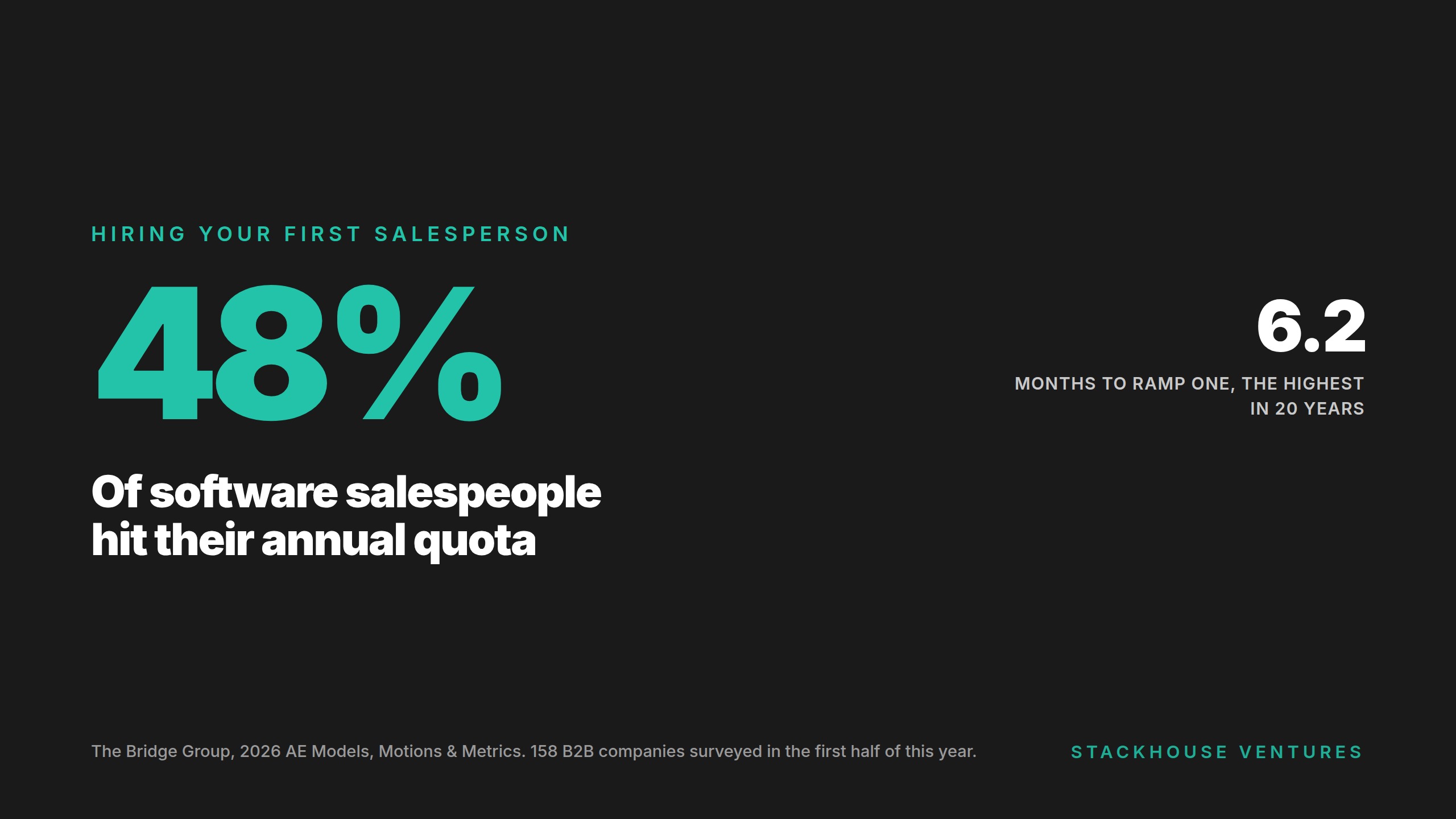
48% of reps achieved annual quota in 2026, down from 51% in 2024.
Look at where that number comes from. Those are companies with sales managers, enablement teams, CRM administrators, and a pitch somebody else already wrote and tested. MinistryLink has none of that. If you're reading this, you probably don't either, which means we're both looking at a coin flip that was measured under better conditions than ours.
Second number from the same survey: ramp time reached 6.2 months, the highest in the study's 20-year history. Companies are also demanding more experience at hire than they used to, an average of 3.7 years against 2.7 years in 2022.
Third number: median on-target earnings hit $200,000, up from $190,000 in 2024. Median quota is $960,000.
Multiply the first 2 together. At $200,000 of on-target earnings, 6.2 months of ramp is roughly $103,000 spent before anybody expects results, on a person with a coin-flip chance of hitting their number.
Reps Selling Small Deals Miss Quota The Most
RepVue is a site where salespeople rate their employers, which gives it a view of quota attainment that surveys of sales leaders can't reach. Their quarterly index runs on ratings submitted by quota-carrying reps, 58,500 ratings across 252 companies in the second quarter of this year.
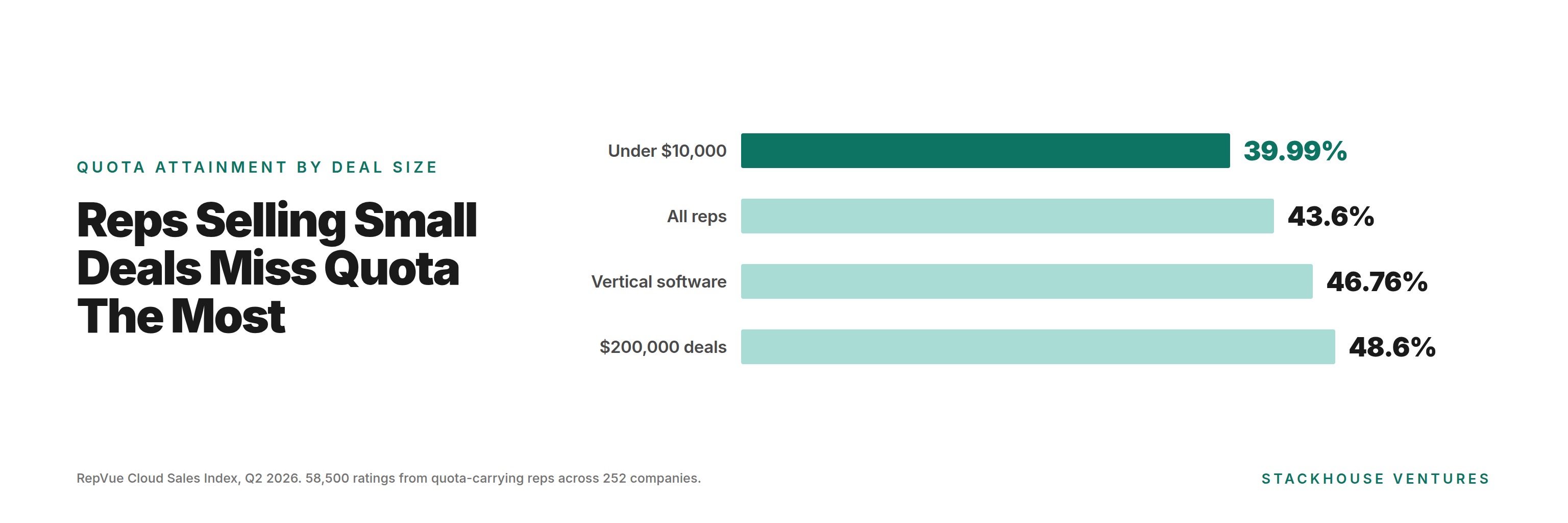
Overall quota attainment came in at 43.6%.
Then they cut it by deal size, and this is the number that gave me pause.
Reps selling deals under $10,000 hit quota 39.99% of the time, and that figure fell almost a point year over year while the rest of the index rose. Reps selling $200,000 deals hit quota 48.6% of the time.
Most church software sells in that bottom band. If that's where your pricing sits, the segment we'd both be hiring into is the worst-performing one in the index, and it's getting worse.
One piece of good news in the same report: vertical industry software posted the strongest year-over-year gain for a second consecutive quarter, rising to 46.76% attainment. Selling into one industry helps. It does not get you above a coin flip.
Who Your Salesperson Would Actually Be Calling
The National Congregations Study is the strongest sample anybody has in this market, 1,262 congregations in a nationally representative survey run out of Duke. It found that 14.3% of congregations have no paid staff at all, 37.2% have no full-time staff, and the median congregation has exactly 1 full-time employee.
So the person picking up the call is often a part-time bookkeeper, an office administrator, or the pastor between hospital visits. Anybody who has sold into this market has had all 3 conversations.
Then look at who decides. Lifeway asked 1,004 Protestant pastors who builds the church budget, and the answers overlap heavily: trustees or the church board 77%, the treasurer 69%, the pastor 61%, a finance or stewardship committee 58%.
That's a committee sale to volunteers, on a calendar none of us control, at a price that won't cover a normal commission. A rep with 3.7 years of software sales experience has closed nothing that looks like it, and that is what every one of us is hiring against.
These Surveys Describe Companies With Sales Teams
These surveys describe companies with sales departments. Bridge Group's respondents are CROs and VPs of Sales, which means every company in that sample already made the hire we're both contemplating, probably several times over.
Nobody surveys the first sales hire at a $600,000 company, because there is no VP of Sales there to fill out the form.
So read these numbers as a description of the conditions the hire will be working in. A great first rep at a small company can beat every one of them, and some do. What the surveys give us is a sense of how much has to go right for that to happen.
5 Tests To Run Before You Hire Your First Salesperson
Have You Personally Closed 20 Customers?
Jason Lemkin built EchoSign, sold it to Adobe in 2011, and now runs SaaStr, the largest community of B2B software founders. He has been consistent on this point for years, and his version is the tightest: "You should hire your first AE (Account Executive) once you've closed at least 10-20 customers yourself as the founder."
Bessemer Venture Partners is one of the oldest venture firms in the country and publishes the most widely used free operating benchmarks in software. Their founder playbook says something similar, attributing it to Paul Fifield, a 4-time founder and one of their operating advisors: founders should drive the first 20 or so customers themselves.
This has nothing to do with grit. Until you've closed 20 deals, you don't know which objections are real, which segment converts, or what the actual sequence is. You end up handing your new rep a job description where a process should be, and then blaming them when it doesn't work.
This is the test MinistryLink passes cleanly. Every dollar from $50,000 to the mid-six figures came from us selling. We know the objections because we have heard all of them, and we know which ones kill a deal.
Does Your Contract Value Support A Salesperson At All?
Lemkin's threshold is blunt: "It's only going to make sense to have true inside sales people if your ACV is at least about $2k or so."
Checking that takes 4 lines of arithmetic. I worked a version of this for MinistryLink, and the one below uses market numbers so you can follow along with your own.
- Start with what the rep costs. Bridge Group's 2026 median on-target earnings is $200,000. That's base salary plus commission, assuming they hit their number.
- Multiply by the quota ratio. Companies expect a rep to sell roughly 4.6 times what they are paid, which is Bridge Group's 2026 median. At $200,000 in pay, that rep is carrying a $920,000 quota.
- Divide by your price. If a church pays you $2,000 a year, the rep has to close 460 new churches in 12 months to hit that quota. If a church pays you $12,000 a year, it's 77 churches.
- Compare that to how many churches you closed last year, total, with you doing the selling.
460 is not a number any first rep hits in this market. 77 might be.
Your own version will use smaller numbers, because a first hire won't carry a full market quota and a junior rep costs well under $200,000. The ratio is what matters, though, and it holds at any salary. Run the 4 lines with your real price and your real pipeline.
When the answer comes back needing more churches than exist in your entire target segment, you have a pricing problem. Hiring a salesperson does not fix a pricing problem.
Can You Describe The Sale In Writing?
Write down the sequence. Who you call first, what you send them, what they ask, who else has to approve it, how long each step takes, and what makes a deal die.
If you can write that in a page and it's true for 8 of your last 10 deals, you have something to hand somebody.
If every deal happened differently and closed because you personally knew the person, what you have is a set of relationships. Those are worth a great deal and they don't transfer with a job offer, which is a distinction I had to work through honestly before we opened our own search.
How Will You Get A Second Data Point?
This is Lemkin's argument, and I think he's right: "If your first rep does poorly, you'll have no idea why. If your first rep does well, you'll still have no idea why."
With one rep and a 48% base rate, a miss tells you nothing. You can't separate the person from the motion, so you fire somebody who was fine, or you keep somebody who was lucky.
His fix is to hire 2 at once. Almost nobody reading this can put 2 full-time salespeople on payroll, and that constraint is real.
What you actually need is a comparison. A second salary is one way to buy one, and at our size it is the most expensive way. There are 4 cheaper ways to get the same signal.
- Keep selling half the deals yourself and use your own close rate as the control. Same leads, same season, 2 people working them. A rep closing at half your rate is a ramping problem you can coach. A rep closing at a tenth of it is a hiring mistake you can correct in 90 days.
- Hire 2 part-time reps for the price of one full-timer. Church software attracts people who want 20 hours a week more than they want a career quota, and 2 half-time reps produce 2 data points on the same budget.
- Split the market by segment and let the results do the comparing. Give the new rep the segment you have had the least success in, and keep the one you know cold. Within 2 quarters you will know whether your own results came from the segment or from you.
- Pay commissions to people who already sell to churches. There are consultants and integrators in this market with 40 church relationships apiece. A referral commission costs you nothing until it produces revenue, and signing 3 of them at once gives you 3 comparisons for no fixed cost. Talk to your accountant about how you structure and classify those agreements before you sign any of them.
We are hiring one person at MinistryLink, which means option 1 is the one I have to make work. The plan is for my pipeline to keep running alongside theirs, because that comparison is the only clean read I will get in year one.
Do You Actually Want To Stop Selling?
Lemkin's line on this is specifically about companies like yours: "For vertical SaaS especially, don't even think about stepping back before $10M ARR."
He puts the first Head of Sales at $2 million to $3 million for sales-led companies, and says vertical companies should keep selling well past that. Bessemer's guidance is that you should be approaching $1 million in ARR before you consider a VP of Sales, and that a VP of Sales should never be an early hire.
In a market this small, the founder on the call is worth more than the pitch. Barna and Pushpay surveyed 1,306 church leaders and found ease of use, price and reputation are the primary drivers for adopting new tools. In church software, reputation attaches to a person, and right now that person is you.
This is the test I am still wrestling with. Lemkin would tell me to keep selling MinistryLink myself for years. The counterargument is that the ladder we climbed was built entirely on my calendar, and a business whose growth depends on one person's calendar has a ceiling somewhere.
So we are hiring somebody to sell alongside us, and I am keeping the accounts where the relationship is the product. That is the compromise we settled on, and I'll know in a year whether it was the right one.
The Hire That Comes Before This One
For most companies reading this, the right hire is not a salesperson yet.
It's somebody who takes the work around the sale off your plate while you keep the sale. Somebody to run outreach and book the calls you take. Somebody who handles onboarding, support, and renewals, so your afternoons come back and you only touch new business.
That person costs half a salesperson, ramps in weeks, and gives you back the hours you were trying to buy in the first place. You keep the calls, which is where you learn what your product should do next.
MinistryLink went through that stage already, which is the only reason we are having the salesperson conversation now. If you're at $200,000 and reading this because you're exhausted, the exhaustion is real and a commissioned rep is not the answer to it.
How We Are Qualifying Candidates
This is the part we are still working out, and I'd rather show you the draft than pretend it's finished.
The benchmarks pushed me toward 4 questions I want in our interviews.
- Walk me through the last deal you closed over $10,000 in annual value. What did the process look like?
- Who were the other people in the room on that deal, and how did you handle the ones who never got on a call?
- Describe a sale where the budget cycle ran longer than your quarter. What did you do in the gap?
- What would you need from me in your first 90 days to be productive by month 4?
Set the dollar figure in question 1 at your own deal size and hold the line there.
One thing to flag about my own example, because MinistryLink is an imperfect analog for most of you. Our buyer is a marketing leader at a software company, and our deals run in the tens of thousands a year depending on term length, which is why $10,000 is the floor we use on that question.
If you sell church software at $1,200 a year, your number is different and so is the rep you want. Use your own median deal.
RepVue's index shows how much the motion changes across deal sizes: 39.99% quota attainment under $10,000 against 48.6% above $200,000, with sales cycles running 37 days at the bottom of that range and 225 days at the top. A candidate whose career sits an order of magnitude away from your price is walking into a motion they have never run.
Questions 2 and 3 exist because of how both of these markets buy. Ours runs on annual commitments negotiated against somebody's marketing budget. Yours runs on a church board and a fiscal year that starts in January for 74% of Protestant congregations. Either way, people who never get on your call decide the outcome, and the budget cycle is longer than a sales quarter. A rep who has only sold to a single decision-maker inside 90 days has no instinct for either.
The fourth question is the one I care about most. A candidate who has a real answer has ramped before and knows what it took. A candidate who says they'll figure it out is telling you they expect you to build the process, which puts you back where you started.
Your Assignment This Week
Pull your last 10 closed deals and answer 3 questions about them.
- How many closed because of something only you could have said?
- What is the median number of days from first conversation to signature?
- If you handed all 10 to a stranger with 3 years of software sales experience and no church background, how many would still have closed?
The third number is the one that decides this. Under 5 means you aren't hiring a salesperson yet, you're hiring help so that you can keep selling.
I ran something similar to this thought process and prep for MinistryLink before we opened the search, and I'd encourage you to run it before you open yours.
If you want to be in a room with founders working through this same hire, including the ones who made it 18 months too early and can tell you what it cost, that's what the Builder Conference is. Jackson Hole, this November. I'll have an answer by then on how ours went.
How many of your deals closed because it was you on the call?
Sources and Further Reading
- The Bridge Group, 2026 AE Models, Motions & Metrics, June 2026. 158 B2B companies. Quota attainment, ramp time, compensation and the quota-to-OTE ratio. Tenth edition of a study running since 2006, and they disclose their own selection bias, which is more than most do.
- RepVue Cloud Sales Index, Q2 2026. 58,500 ratings from quota-carrying reps across 252 companies. The deal-size breakdown is the most useful thing published on this subject.
- Jason Lemkin, when to hire your first AE, June 2025.
- Jason Lemkin, on transitioning out of founder-led sales, August 2025. The vertical SaaS threshold.
- Jason Lemkin, hire 2 reps not one. Written in 2013 and still the best argument on the subject.
- Bessemer Venture Partners, The founder's playbook for scaling to $1 million ARR, 2025.
- Salesforce, State of Sales. 5,500 sales professionals, though the quota figures date to 2024 and the newer edition does not publish them.