
A church with 4,000 people wants your product, with one change. They will pay $40,000 for the change.
That's more than most of your customers pay you in a decade. Every founder I know in this market has taken that deal at least once.
Worth knowing how unusual that church is. The Faith Communities Today study surveyed 7,453 congregations in late 2025 and put median worship attendance at 70 and median congregational income at $205,000. A church that can write a $40,000 check for custom software sits in a very thin slice of this market, which is exactly what makes the offer hard to turn down.
Before you take the next one, look at what it does to the numbers somebody will eventually use to value your company.
What Buyers Pay For Software Versus Services
Aventis Advisors is an M&A advisory firm that tracks software and IT services transactions through Mergermarket. Same analyst, same data provider, same window.
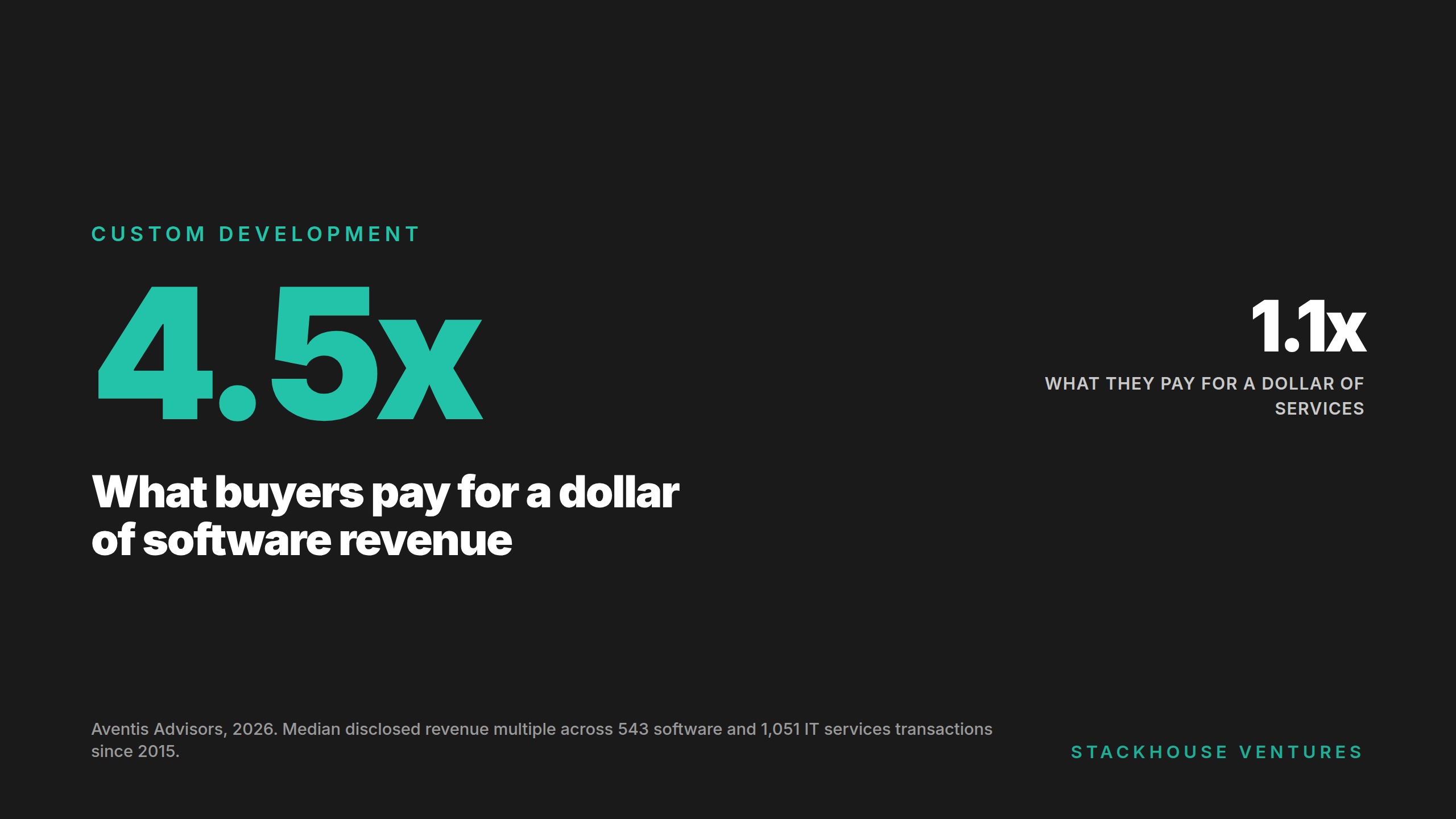
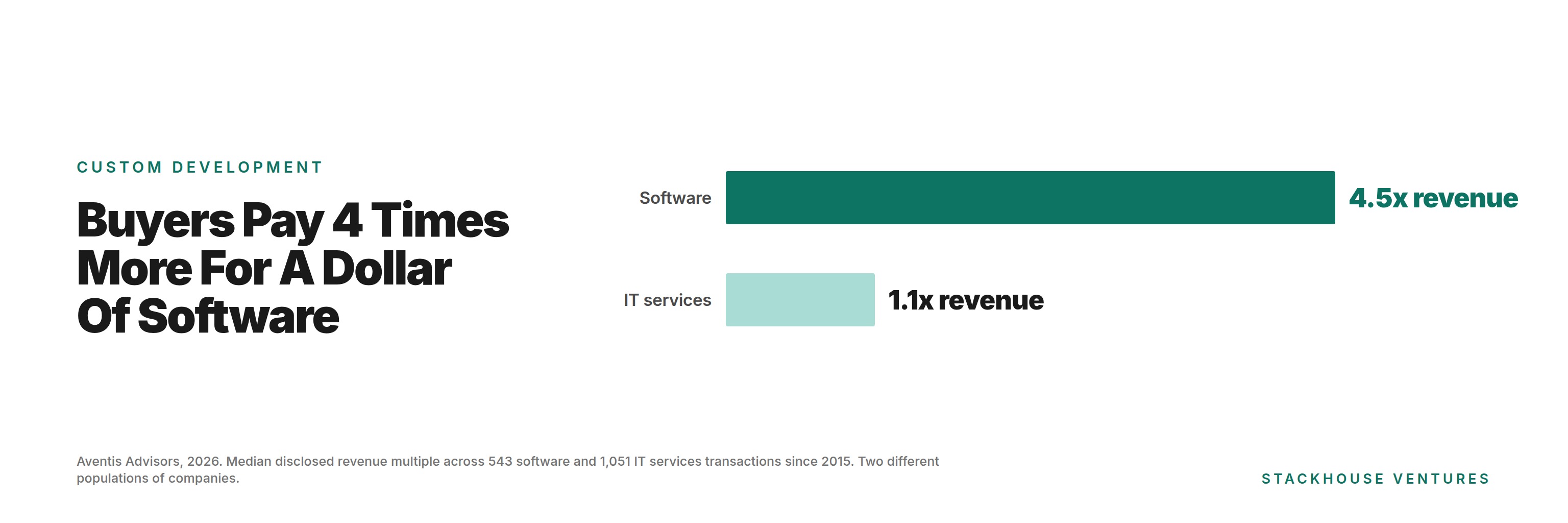
Private software companies sold at a median of 4.5 times revenue, from 543 transactions with a disclosed revenue multiple since 2015.
IT services companies sold at a median of 1.1 times revenue, from 1,051 disclosed deals over the same period.
Be careful how you read that. Those are 2 different populations of companies, and nobody has published what happens to a single company as its services mix climbs.
What it does tell you is what buyers pay for a dollar of software revenue against a dollar of services revenue. A dollar of custom development is worth roughly a quarter of a dollar of subscription, and that difference follows you all the way to a sale.
What Services Do To Your Margin
Benchmarkit's 2025 survey puts professional services at about 15% of total revenue at the median across the software companies it covers.
The margin arithmetic is the part worth memorizing. Subscription gross margin runs 81% at the median, professional services runs about 30%, and blending them at a 15% services mix puts you at 77% total.
Benchmarkit then names the line where it breaks, and this is the single most useful sentence I found on the subject: "If a SaaS company's mix of Professional Services revenue to Subscription revenue exceeds 15-20% of total revenue and/or if Services Gross Margin is lower than 30%, the Total Gross Margin is likely to be lower than the median benchmark of 77%".
One caveat you should know: the gross margin question in that survey was answered by 76 companies out of the full 583. Treat the margins as directional.
Bessemer Venture Partners is one of the oldest venture firms in the country and publishes the most widely used free operating benchmarks in software. Their Christine Deakers puts the same point without hedging: "I'll be very blunt: professional services revenue is bad for cloud businesses in most cases." Her reasoning is that it carries low gross margin, slows implementations, and only scales in proportion to headcount.
These Numbers Come From Bigger Companies Than Yours
Every dataset here comes from companies much larger than yours. SaaS Capital's smallest usable band is $3 million to $5 million in ARR. Benchmarkit skews larger still. Aventis is measuring M&A transactions.
At $400,000 in revenue, none of these samples include you. Treat them as the norms you'll be measured against later, once somebody is looking at your books.
There's also a real counterargument nobody in this data addresses. At your size, $40,000 of services revenue might be the thing that keeps the lights on long enough to finish the product. A margin benchmark built on $20 million companies has nothing to say about payroll in March.
The rules below are about taking that money without letting it reshape the company.
5 Rules For Taking Custom Work
Keep Services Under 15% Of Revenue
This is the one number to hold. Benchmarkit's threshold is 15 to 20% of total revenue before blended margin starts breaking down, and Jason Lemkin, who built EchoSign and now runs SaaStr, puts the enterprise SaaS norm even lower, at 8 to 10% of revenue.
At $400,000 in revenue, 15% is $60,000 a year. One $40,000 project uses two-thirds of your annual allowance.
Write that number down before the next request arrives, because you won't compute it in the moment with a big church on the phone.
Put Services On A Separate Line In Your Books
FE International is a brokerage that has handled more than 1,500 software company sales, and they call this the cheapest valuation improvement available to a small software company: "If your business blends software and services, separating the two cleanly in your financials is one of the cheapest valuation improvements available to you."
They also describe how buyers actually read the number: "Gross margin functions as a gate rather than a slider. Above roughly 75% a business is treated as software. Below 70% buyers start asking which part of the revenue is really services, and they price that part differently."
Their premium and discount table lists services clearly separated as a premium and services bundled as a discount. That's a formatting decision in QuickBooks worth real money, and it takes an afternoon.
Never Let One Customer Pass 15% Of Revenue
The famous 10% rule comes out of accounting rules. FASB's segment reporting standard requires a public company to disclose any single customer representing 10% or more of revenue. That is a disclosure trigger, and it is where the folklore started.
The version that applies to you comes from FE International's actual deal terms: a single customer above 15% of ARR triggers a discount, and no customer above 10% earns a premium.
Custom work is how concentration happens. The church that paid for the feature becomes the church that owns your roadmap, and 3 years later they're 22% of revenue and every decision runs through them.
Charge Enough That You Would Be Happy To Lose The Deal
Lemkin's rule of thumb is up to 20% of annual contract value for services on larger deals, and his advice on margin is that breaking even on services is usually good enough.
At your size, price it higher than that. You're not running a services organization with utilization targets. You're taking your only engineer off the product for 6 weeks, and the real cost is the roadmap you didn't build.
Price the work at what it would take for you to be genuinely glad you did it, including the delay to everything else. If the customer says no at that price, you've learned the feature wasn't worth $40,000 to them, which tells you something about whether to build it at all.
Build It For Everybody Or Do Not Build It
The only custom work worth taking is work you would have built anyway.
Before you say yes, ask whether 10 other churches in your segment would use this. If the answer is yes, the customer is funding your roadmap and you should take the money and ship it to everyone.
If the answer is no, you're being paid once to maintain something forever. That maintenance is invisible in year one, and it's the reason small vertical companies get slow.
The version that always fails is the one where you say yes, build it as a one-off behind a configuration flag, and tell yourself you'll generalize it later. You won't. It sits in the codebase and every future change has to work around it.
The Denominational Version Of This Offer
The harder call comes from a whole denomination.
The 2020 U.S. Religion Census counted 12,739 Assemblies of God congregations, 8,857 in the Evangelical Lutheran Church in America, and 8,851 in the Presbyterian Church (USA). When a body that size asks for a custom rollout, the customer count in the room makes almost any amount of work look justified.
Run the same tests anyway. What share of your revenue would that one relationship represent. Would the other churches in your segment use what you build. What happens to you if the 2 denominational staff who championed it take jobs somewhere else.
Jeff Berg of Planning Center has the line worth keeping in your head when this call comes: "In order to have a good yes, you have to have a whole bunch of hard no's as well."
What This Costs You In Engineering Terms
SaaS Capital's 2026 survey puts R&D at 24% of revenue for companies in the $3 million to $5 million band, from a survey of more than 1,000 private companies.
At $400,000 in revenue, a proportional R&D budget is $96,000 a year. That is most of one engineer.
So a 6-week custom build isn't 6 weeks of somebody's time. It's roughly 12% of your entire annual product capacity, spent on one customer, on something the other 59 will never see.
That's the trade you're making. Sometimes it's the right one, and it is never a free $40,000.
Your Assignment This Week
Go through last year's revenue and split it into 2 columns.
- Subscription revenue that renews without you doing anything new.
- Everything else: setup fees, custom builds, migrations, training, consulting.
Then answer 3 questions.
- What percentage is column 2?
- What is your gross margin on each column, counting your own hours honestly?
- What share of total revenue comes from your single largest customer?
If column 2 is over 20%, or your largest customer is over 15%, you're running a services company that thinks it's a software company. That's fixable, and it's much easier to fix at $400,000 than at $4 million.
If you want to be in a room with founders who took the custom work and can tell you how it went, that is what the Builder Conference is. Jackson Hole, this November.
What percentage of your revenue renews without you building anything?
Sources and Further Reading
- Aventis Advisors, SaaS valuation multiples and IT services valuation multiples, 2026. Same analyst and data source, which is what makes the 4.5x against 1.1x comparison usable.
- Benchmarkit, 2025 B2B SaaS Performance Metrics Benchmarks, May 2025. The services mix threshold and the margin arithmetic. Note the gross margin question had 76 respondents.
- Bessemer Venture Partners, The five accounting metrics for cloud companies. The bluntest statement any named firm has published on services revenue.
- FE International, SaaS Valuation Multiples in 2026, August 2026. The gross margin gate, the concentration thresholds, and the separate-your-books advice.
- FASB ASC 280-10-50-42 on major customer disclosure. Where the 10% customer concentration rule actually originates.
- Jason Lemkin, how much a SaaS company should invest in professional services, October 2024. Named company comparisons from Qualtrics down to HubSpot.
- SaaS Capital, 2026 Spending Benchmarks, June 2026. R&D and services cost as a share of revenue by company size.