
I spent an afternoon looking up what church software actually costs. I went to each company's own pricing page, because the review sites are almost always out of date.
I checked 9 companies. Only 5 of them publish a real subscription price.
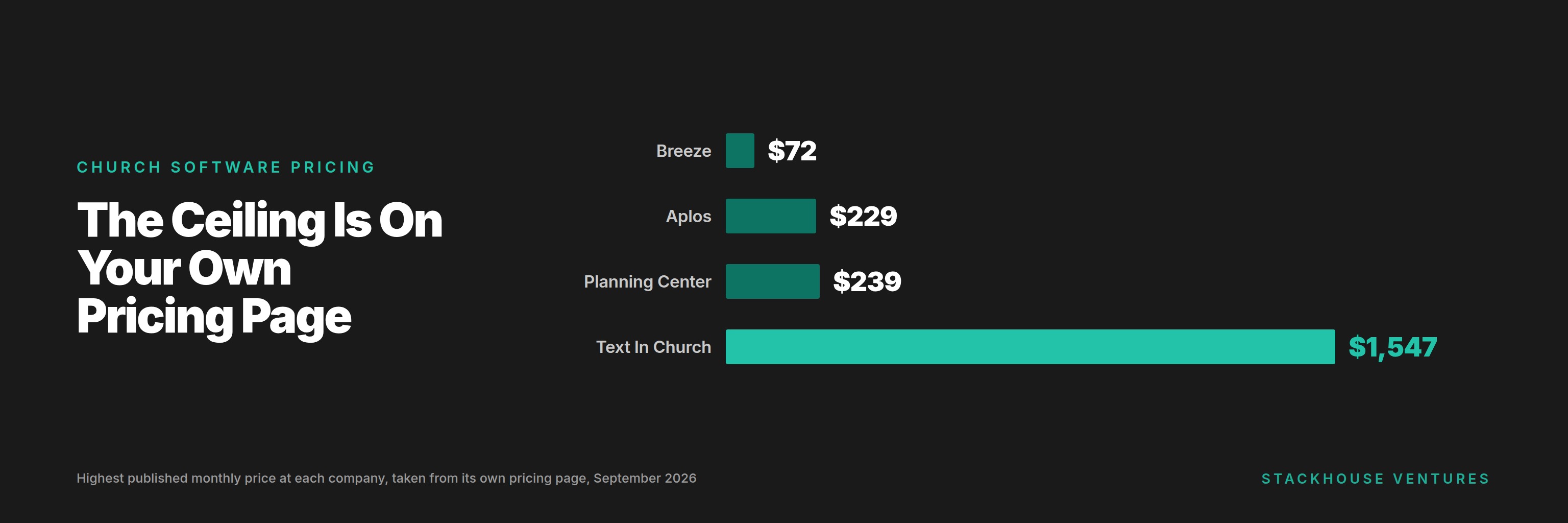
This is where I expected the story to end. Breeze charges $72 a month flat and says right on the page that there are no tiers or limits based on how much your church grows. Tithe.ly's church management plan is also $72. Text In Church shows 3 plans at $37, $67, and $97. Aplos runs $79, $129, and $229. Planning Center's ladder climbs $15, $32, $69, $115, $179, and stops at $239 for a single product.
That's a tight band, and just about every founder I talk to in this market prices somewhere inside it.
Click The Link At The Bottom Of The Page
At the bottom of the Text In Church pricing page there's a small link saying you might need a larger plan.
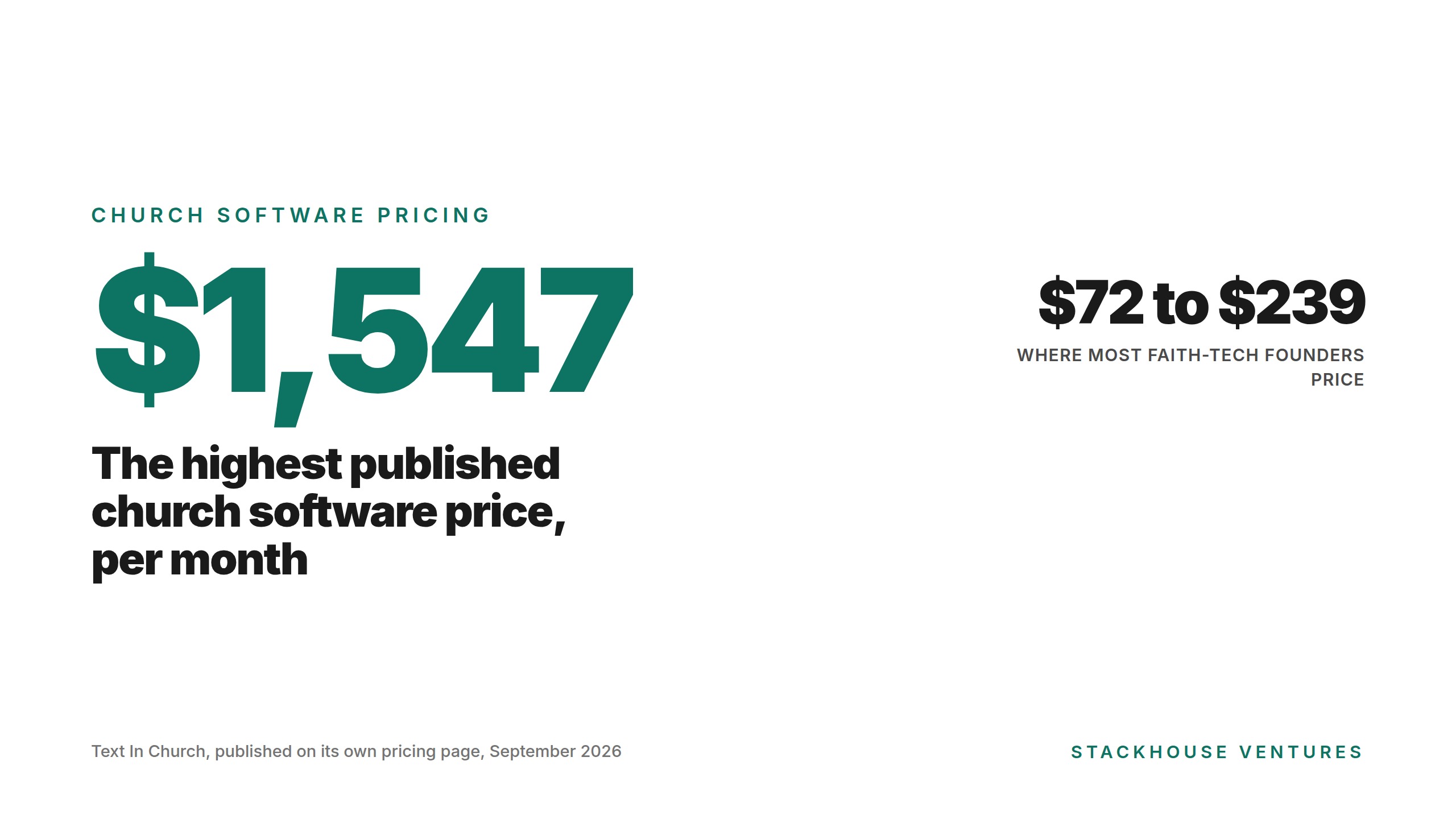
Click it. The published prices keep going: $127, $197, and $337, then $447, $797, and $1,547 a month.
That top plan runs $18,564 a year for church text messaging, and you can put it on a credit card without ever talking to a salesperson.
Now put that number next to the rest of the software industry. SaaS Capital ran their 15th annual survey of private B2B software companies this year, more than 1,000 of them, and the median annual deal size came in at $24,266, down from $26,265 the year before.
So the top of the published church software market is $18,564, and the median software deal across the whole private B2B market is $24,266. Those 2 numbers sit a lot closer together than the $72-a-month conversation in our industry would have you believe.
That's only the published half, too. The companies charging the most in this market show no prices at all. Pushpay's pricing page walks you through 3 products with 3 tiers each, twice over for churches and parishes, and the only dollar figure anywhere on it is a marketing statistic. Subsplash publishes a number for its free giving tier and says everything else depends on church size and usage. Ministry Brands doesn't even have a pricing page; the URL returns a 404. Gloo says on its own pricing page that it doesn't offer template pricing, and that its customers "invest between $50K and $1MM+ annually in software and services."
So the ceiling in this market sits wherever your own pricing page stops.
Why These Benchmarks Skip Companies Your Size
Let me be straight about the limits of what I'm about to cite.
Most pricing benchmarks in software start at $1 million or $3 million in annual revenue. SaaS Capital's bootstrapped study covers $3 million to $20 million. If you're doing $200,000 a year in revenue, you're in none of those datasets, because nobody is surveying companies your size.
I use this data as a direction to walk in. Anyone who hands you a benchmark built on $10 million companies and tells you it applies cleanly to yours hasn't thought about it very hard.
5 Ways To Raise Your Prices In The Church Software Market
Charge For Something That Grows Without You
Look at what the published players meter.
Planning Center bills on the number of donations processed each month, daily check-ins, group members, and rooms managed. Text In Church bills on texts sent, which is exactly how a $37 plan turns into a $1,547 plan with nobody renegotiating anything. Aplos bills on user seats. Breeze meters nothing at all and charges one flat rate no matter how big the church gets.
If no part of your price is attached to a number that grows inside your customer, your revenue per account is fixed the day they sign. The only way up is a price increase you have to go ask for, one customer at a time, on a phone call you'll keep postponing.
So name the number inside your customer that goes up every year. Attendance, donations processed, staff seats, records stored, messages sent. Attach some part of your price to it and your revenue grows when their ministry grows.
Find Out What Your Buyer Is Really Comparing You To
Breeze publishes a competitor comparison table on its own pricing page, and it lists Pushpay Church Management at "$100 to $300+ /mo."
Pushpay publishes no prices anywhere. So that range came from somewhere other than Pushpay.
Most of us in this market are guessing at each other's prices and then pricing against the guess. It's an easy habit to fall into when half the industry publishes nothing.
Call your last 10 customers. Ask what else they looked at, what they were paying before you, and what the internal conversation sounded like when they decided. You'll find out you're being compared to something you never considered a competitor, and that the number in your buyer's head came from a product you've never even used.
Raise The Price For New Customers Before You Touch Anyone Existing
This is the version with no downside. Every existing contract stays exactly where it is, nobody gets an email about a price change, and nobody churns over it.
Raise your new-customer price 20% and watch your next 20 deals. Close rate is the whole answer. If it stays where it was, you left money on the table and you now know it. If it drops noticeably, you have your answer inside 60 days, and you can put the price back.
Most founders skip this because it feels permanent. You can reverse it on Monday.
Put A Date On Your Next Price Review
SBI absorbed Price Intelligently, which ran the best-known research on software pricing. They surveyed 321 operators and executives who own pricing decisions. Among companies at $50 million in annual revenue or less: 6% never raise prices, 28% do it on an ad hoc basis, and 23% do it every few years. Only 28% raise annually, with another 16% raising at contract renewal. That group is 3 times more likely than midmarket companies to never raise prices at all.
Kyle Poyar, who spent years at OpenView Partners and now writes the Growth Unhinged newsletter, surveyed more than 230 B2B software and AI companies in April and May of this year. 3 in 4 changed either pricing or packaging within the last year.
Pricing doesn't review itself, so pick a date, put it on the calendar, and make it recur. The useful slot in this market is right after the fiscal year turns over for most of the churches you sell to, because that's when you have the freshest read on what they budgeted.
Build The Tier Above The One You Think Is Your Top
Text In Church didn't stumble into $1,547 a month. Somebody sat down and built 6 plans above the $97 one, then put them behind a link for the churches that need them.
Most pricing pages in this market stop at the tier the founder's biggest current customer happens to buy. You built that ceiling yourself, out of what you already know.
Go look at your largest 3 accounts and ask what the plan above theirs would include. Then build it. Whether you publish that tier or make people call you for it is a separate decision, and you can do both. Publish your first 2 or 3 tiers so a small church can sign up at 11pm on a Tuesday, then put "talk to us" on the top one so you can size the number to the church in front of you.
Nobody can buy a plan you never built.
What A Price Increase Is Actually Worth
McKinsey published a line in 2003 that's been quoted ever since. Marn, Roegner and Zawada wrote that on the average income statement of an S&P 1500 company, "a price rise of 1 percent, if volumes remained stable, would generate an 8 percent increase in operating profits."
Know what that sentence is before you quote it at somebody. McKinsey ran arithmetic on an average income statement. They didn't study a group of companies that raised prices and then report what happened to them. Price flows straight to the bottom line because it costs nothing to produce, and the phrase "if volumes remained stable" is doing most of the work.
At your size, do the arithmetic yourself. It's simple and the answer is specific to you.
Say you're at $300,000 across 60 customers. Your average customer pays you $5,000 a year, so 2 more customers is $10,000. A 15% increase on new business is $750 for every deal you sign after the change, which means it beats those 2 customers once you close about 14 new accounts in the year.
If you're signing more than 14 new accounts a year, the price change is your bigger lever, and you can do it in an afternoon. If you're signing fewer, raise the price anyway, and be honest with yourself that new logos are the thing moving your revenue this year.
Most founders in this market spend the week adding customers to a number they set 2 years ago without much thought, on a pricing page that stops well short of what a competitor is already charging.
Your Assignment This Week
Open your own pricing page and write down 3 numbers.
- What does your most expensive customer pay you per year?
- What does your median customer pay you per year?
- What is the largest amount you've ever charged anyone, counting setup and one-time fees?
If number 3 is bigger than number 1, somebody was already willing to pay you more than your pricing page allows, and you ran the experiment without noticing.
Then find the 5 churches on your list that would be in real trouble on Monday if you shut down. Those are the accounts where you're charging furthest below what you're worth. Raise those first.
If you want to be in a room with founders who've already worked through their own pricing, including the ones who raised too late and can tell you what it cost them, that's what the Builder Conference is. Jackson Hole, this November.
What's the most anyone has ever paid you?
Sources and Further Reading
- SaaS Capital, average deal size for private SaaS companies, August 2026. The $24,266 median deal size, plus the split between bootstrapped and equity-backed companies.
- SBI, 2025 State of SaaS Pricing, Part 2. Survey of 321 people who own pricing decisions. The price increase cadence tables are worth the download on their own.
- Kyle Poyar, The State of B2B Monetization in 2026, May 2026. The best current read on how software companies are changing pricing and packaging.
- McKinsey, The Power of Pricing, February 2003. Read it in full so you understand the assumption behind the 8% figure before you repeat it.
- SaaS Capital, benchmarking metrics for bootstrapped SaaS companies, April 2026. The closest thing to a benchmark set for companies that never raised money.
- Pricing pages checked for this piece: Planning Center, Breeze, Tithe.ly, Text In Church, Aplos, Subsplash, Pushpay, Gloo, and Ministry Brands. Verified September 2026 and subject to change.