
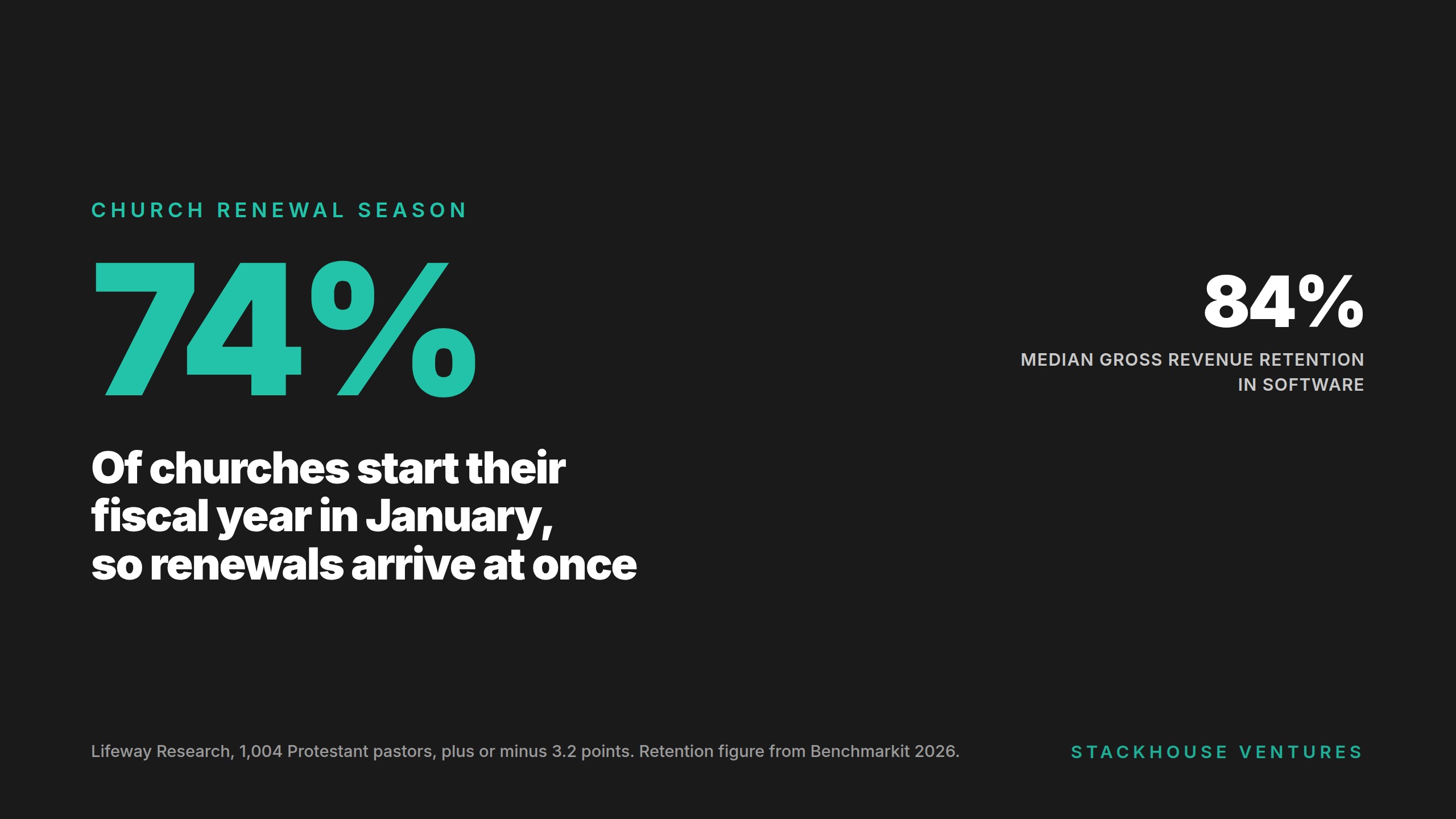
Lifeway Research called 1,004 Protestant pastors and asked a question nobody thinks to ask.
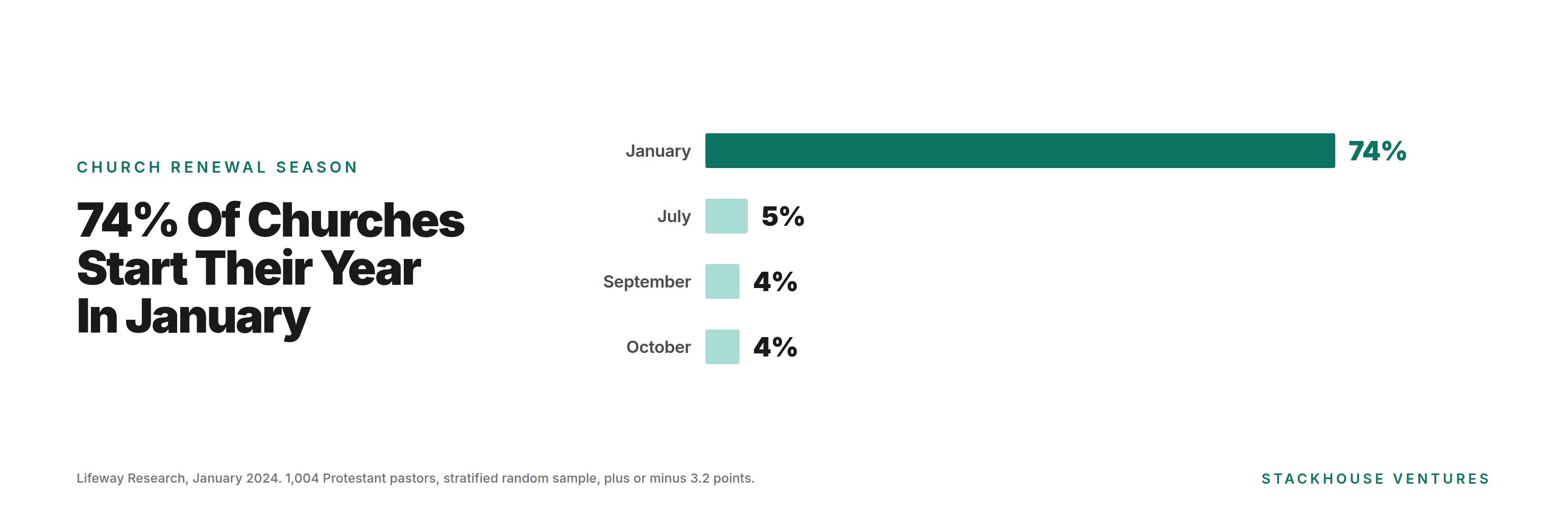
74% said their church's fiscal year starts in January. It was a stratified random sample with a margin of error of plus or minus 3.2 points, which makes it one of the few genuinely solid numbers in this market.
July came second at 5%. September and October tied at 4%.
If you're selling annual contracts to churches, your whole renewal book comes due in the same 6 weeks. Everything you learn about whether customers are staying, you learn at once, in December, when there's nothing left to do about it.
The Retention Number Most Founders Never Compute
Benchmarkit is a benchmarking firm that surveys hundreds of private software companies every year. Their 2026 report covers 342 of them. Their gross revenue retention finding is the one worth reading twice.
Median GRR came in at 84%, down from 88% the year before. The 25th percentile fell from 81% to 76%. Benchmarkit calls this the most alarming data point in the report and notes that top performers were not spared.
At 84%, you're losing 16% of your existing revenue every year before you sell anything new.
Two cuts of that data are aimed squarely at you.
Companies under $5 million in ARR show median net revenue retention of 94%. Read that carefully, because net retention already includes upsells and price increases. The median company at your size is shrinking its existing customer base faster than it can expand it.
And companies with contracts under $5,000 a year show 80% gross retention, against 91% for companies selling $50,000 to $100,000 deals. Small contracts churn harder. That is the market you are in.
For contrast, SaaS Capital's bootstrapped companies at $3 million to $20 million in ARR post 91% gross retention and 103% net, from a survey of more than 1,000 private companies. Those are bigger, more established businesses than yours, and they're the target to walk toward.
Why Your Retention Percentage Is Unreliable
Benchmarkit's sub-$5 million band is the smallest anyone publishes, and it lumps a $600,000 company in with a $4.9 million one. SaaS Capital's floor is $1 million.
Below that, you're measuring something nobody has a benchmark for.
Worse, at your size the percentage itself is unreliable. SaaS Capital's Randall Lucas wrote the piece I wish every small founder read on this, and his example is brutal: "if you lose one equal-sized customer a year (92% GRR), annualizing the one month when you lose that customer will make your GRR seem like 35%".
With 40 customers, one cancellation moves your retention rate 2.5 points, and 2 cancellations in the same month look like a crisis when they might just be a coincidence.
ChartMogul is a subscription analytics platform, which means it computes these numbers for thousands of companies off observed billing data. It won't report a retention figure for a company under $250,000 in ARR. When the people whose job is measuring this impose a floor, that tells you something about the noise below it.
5 Ways To See Your Churn Before Renewal Season
Compare This Month To The Same Month Last Year
Lucas recommends comparing a month against the same month a year earlier. Annualizing a single month, or stacking monthly rates across a year, turns mild seasonality into nonsense.
So: what was your recurring revenue in September of last year from customers who were customers in September of the year before? Divide, and you have a number that is not distorted by which month you happened to look.
Pair it with 3, 6, and 12-month trailing averages. The 12-month number is your reality and the 3-month number is your early warning.
Watch Usage Every Month
In a January renewal market, usage is the only leading indicator you have. A church that stopped logging in during August has already left. Nobody's going to tell you until December.
Pick one action that means the product is doing its job. Volunteers scheduled, donations processed, messages sent, check-ins recorded. Then list every account whose count dropped more than 30% against the same month last year.
That list is your renewal risk, 4 months early, while there's still time to pick up the phone.
Call The Churches That Build Budgets In September
ECFA surveyed church financial administrators and found that budget preparation starts 2.7 months ahead at churches under $500,000 in revenue and 4.0 months ahead at churches above $3 million. That survey is from 2015 and had a low response rate, so treat it as the only published figure on this and give it wide error bars.
Put it next to Lifeway's January finding and the arithmetic is straightforward. Most of your customers decide whether to keep you somewhere between September and mid-October.
By the time you send a renewal notice in December, that decision got made 10 weeks earlier, in a meeting you weren't in.
So move your renewal conversation to September. Not an invoice. A conversation about what they got for their money this year, timed to arrive while the budget is being written.
Count Logos And Dollars Separately
At your size these 2 numbers tell completely different stories, and founders conflate them constantly.
Lose your 3 smallest churches and your logo count drops 5% while revenue barely moves. Lose one multisite customer and revenue drops 12% while your logo count looks fine.
Track both every month. When they move in opposite directions, that is information about which segment is actually working.
SaaS Capital notes that the average gap between gross and net retention runs a bit more than 12 percentage points, with 8 to 20 points being a normal range. If your gap is under 5, you have almost no expansion revenue, and that is a pricing problem showing up in a retention metric.
Decide Whether Annual Billing Is Right For You
ChartMogul analyzed billing patterns across more than 2,500 software companies. For products under $25 in average revenue per account, median customer retention was 62% on annual plans and 41% on monthly. At $250 to $500 ARPA, net revenue retention was 88% annual against 76% monthly.
Annual billing buys retention. It also costs you something, and the same report says so: companies under $1 million ARR taking most of their revenue annually grew 15 to 18% at the median, while the top quartile of monthly-heavy companies under $1 million grew 131%.
So annual contracts buy you cash and stability and cost you speed and visibility. In a January market they also concentrate all your risk into one month.
One option worth considering is annual billing with a quarterly check-in built into the contract. You keep the cash and you manufacture 3 more chances a year to find out something is wrong.
What Annual Billing Hides
Lucas gives one example that every vertical software founder should read before renewal season.
A company where 5 customers cancel in the fourth quarter reports 87.5% gross retention for the full year. The actual fourth-quarter rate had collapsed to 50%.
The annual number is accurate and completely useless. It's describing a business that doesn't exist anymore by the time you calculate it.
This isn't a small-company problem. It's what annual aggregation does in a market where every renewal happens at once, and it gets worse the more concentrated the season is. Yours is about as concentrated as it gets.
NTEN's survey of more than 300 nonprofits found that 62% decide technology spending "Every year as part of fiscal year planning". Your customers are not evaluating you continuously. They evaluate you once, in the fall, and then execute the decision in January.
Your Assignment This Week
Open your billing system and answer 3 questions.
- Of the customers you had in September of last year, how many are still paying you today, and what percentage of that revenue is left?
- Which 5 accounts have the steepest drop in usage against the same month last year?
- What month does each of your 10 largest customers set its budget?
If you cannot answer the third question, that is the week's work. Ask them. Most church administrators will tell you in one email, and that calendar is the single most useful thing you can know about this market.
If you want to be in a room with founders working through their own renewal seasons, that is what the Builder Conference is. Jackson Hole, this November.
When did you last talk to a customer who wasn't renewing or complaining?
Sources and Further Reading
- Lifeway Research on church fiscal years, January 2024. 1,004 Protestant pastors, stratified random sample, plus or minus 3.2 points. One of the few church-market numbers with a real sampling frame behind it.
- Benchmarkit, Annual Benchmark Report 2026, June 2026. 342 companies. The retention section is the part to read.
- SaaS Capital, Benchmarking Metrics for Bootstrapped SaaS Companies, April 2026.
- SaaS Capital, Pitfalls in Measuring SaaS Churn, April 2025. Randall Lucas on why small-company retention math misleads. The most useful thing published on this for companies your size.
- SaaS Capital on the gross-to-net retention gap, August 2023.
- ChartMogul, SaaS Billing Report. More than 2,500 software companies, annual versus monthly billing, with the growth tradeoff stated honestly.
- ECFA Church Financial Management Survey, 2015. Old and self-selected, and still the only published data on church budget timing.
- NTEN, 2024 Nonprofit Digital Investments Report. More than 300 nonprofits on how technology purchasing decisions get made.