
The seed round you read about on LinkedIn is not the one available to you.
Carta is the cap table platform most venture-backed startups run on, which gives it a direct view of what rounds actually cost. They looked at more than 1,000 software fundraising rounds in the first half of this year. The median seed was $4.1 million raised at a $24.3 million post-money valuation, and the founders sold 18% of the company to do it.
Carta also says at least half those companies would be described as AI-native. If you're building church software and doing $400,000 a year in revenue, no fund is offering you $4.1 million on those terms.
That doesn't settle the question. It just means you should answer it with numbers from companies that look like yours.
What The Money Actually Buys
SaaS Capital lends to private software companies, which is why they have 15 years of real financials to survey. This year's edition covers more than 1,000 private B2B software companies. The spending comparison between funded and bootstrapped companies is the clearest thing I've read on this subject.
Equity-backed companies spend 100% more on marketing and 70% more on sales than bootstrapped ones. They also spend 56% more on R&D and 100% more on customer success.
Total spending lands at 101% of ARR for equity-backed companies and 96% for bootstrapped ones.
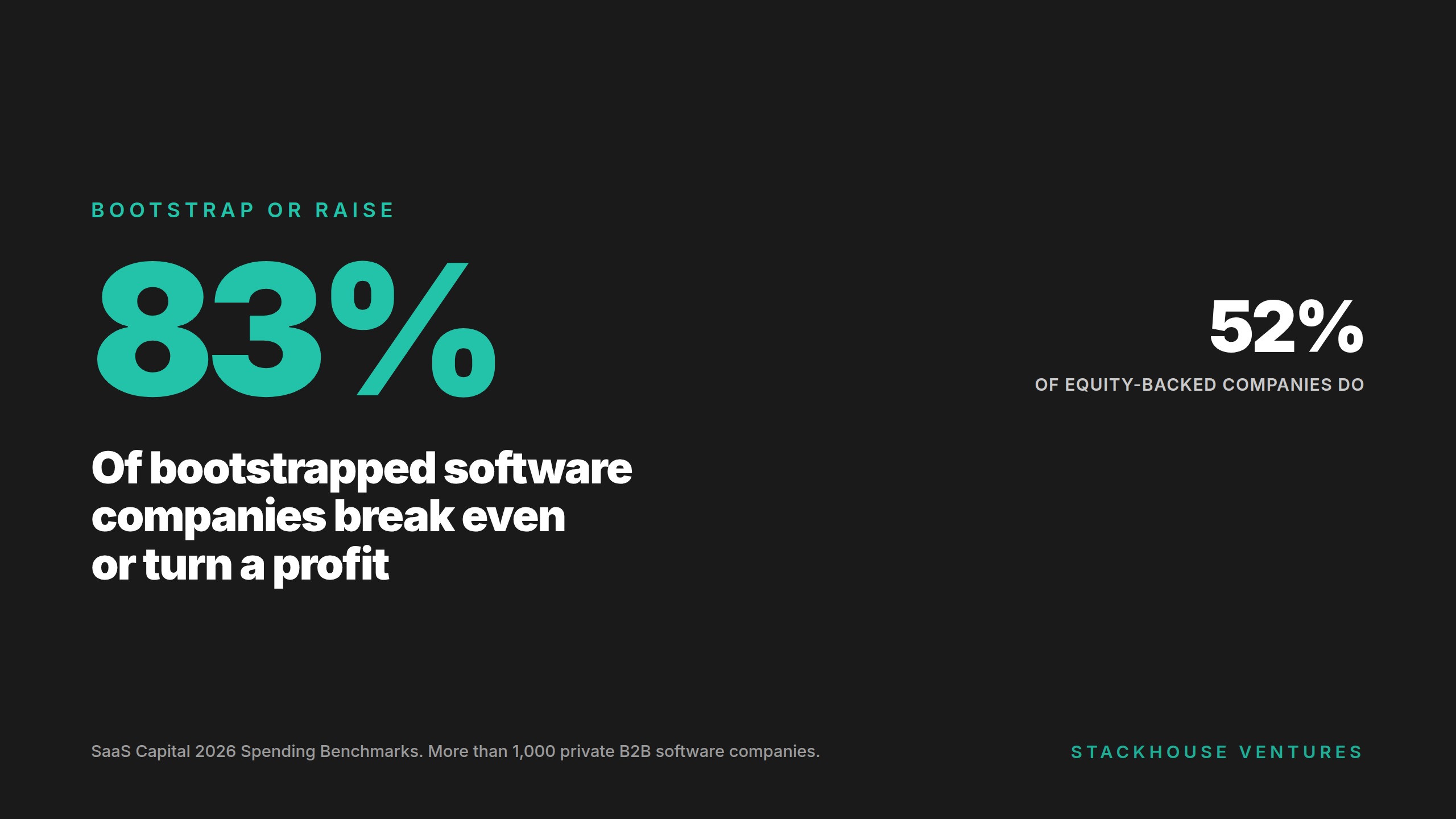
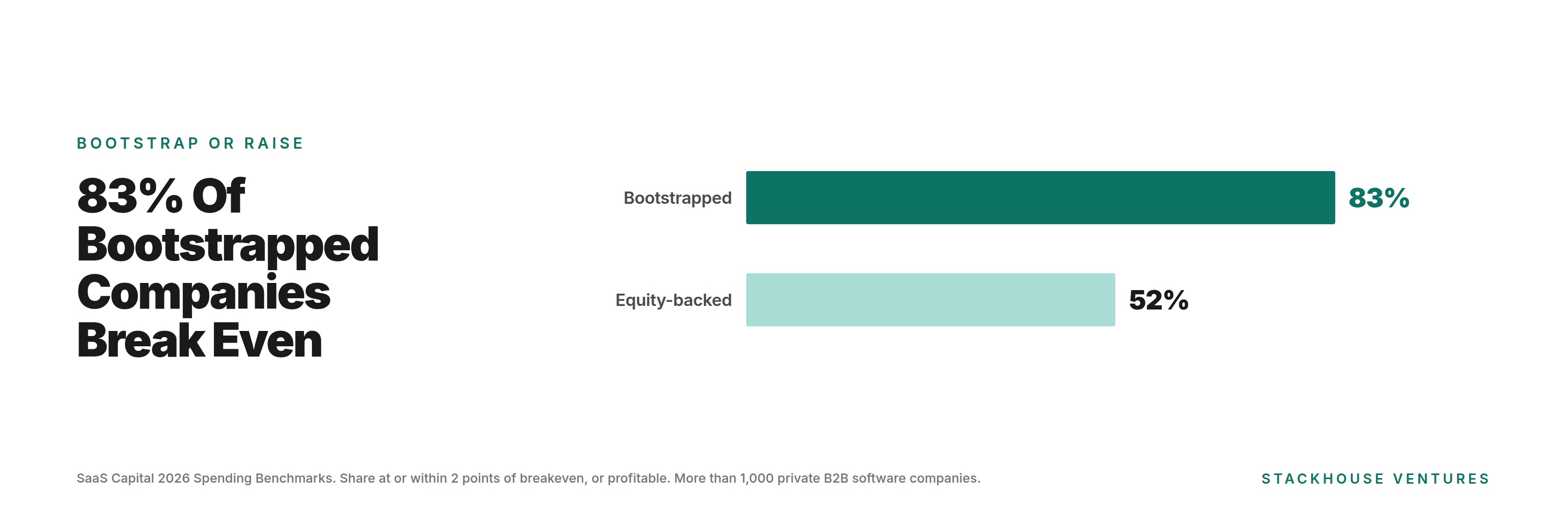
That 5-point difference shows up in the most concrete way possible. In SaaS Capital's words, "83% of bootstrapped companies are operating within two percentage points of breakeven or are profitable while only 52% of equity-backed are breakeven or profitable."
Now the part that surprised me. All that extra spending buys less growth than you'd guess. Bootstrapped companies posted median growth of 20% this year. Equity-backed companies posted 25%.
5 percentage points, for double the marketing budget.
The bootstrapped companies also run leaner per head. At $5 million to $10 million in ARR, bootstrapped companies show median revenue per employee of $177,240 against $152,295 for equity-backed companies at the same size.
The 2 Paths This Market Has Already Run
Church software has produced a clear example of each path, and both are worth knowing before you pick one.
Planning Center started in 2006, when Jeff Berg and Aaron Stewart were both on church staff in Southern California. They have never taken outside money. 20 years on they employ more than 200 people, and Planning Center Giving processes over $600 million in donations a month. Berg's own summary of how they got there: "In order to have a good yes, you have to have a whole bunch of hard no's as well."
Pushpay took the other path. They raised, scaled, bought Church Community Builder for $87.5 million in 2019, reached $202.8 million in revenue by fiscal 2022, and were taken private in 2023 at an implied US$1,015 million.
Both of those are good outcomes. One of those founding teams still owns their company.
What constrains this decision in church software is how many churches can actually buy. Hartford Institute counts about 373,000 congregations, with the largest 13% holding 78% of all churchgoers, which works out to roughly 48,000 churches with the staff and budget to purchase software at all.
A venture return usually needs a path to a $100 million company. Multiply 48,000 by your price, take the share you could realistically win, and see whether that path exists before you take money on the assumption that it does.
Nobody Surveys Companies Under $1 Million
Every dataset I just cited starts at $1 million in ARR. SaaS Capital's smallest published band is $1 million to $3 million. Carta's numbers describe companies that already raised.
If you're doing $300,000 a year in revenue, nobody is surveying you. You are not at the bottom of these charts, you're outside the frame.
I use this data to understand the shape of the tradeoff. Anybody who tells you a benchmark built on $10 million companies settles your decision at $300,000 has not thought about it.
5 Questions To Answer Before You Raise Money
Is The Money Buying Something You Cannot Build Without It?
Most founders raise to grow faster. The spending data says funded companies mostly buy sales and marketing capacity with it, and get 5 more points of growth.
There are real answers to this question. A regulatory approval you have to fund before you can sell. A hardware component. An integration that takes 18 months of engineering before it produces a dollar. A land grab where a competitor with money will take the market while you're building.
"We'd hire 2 salespeople and run ads" is not one of those answers at your size. You can test that with your own cash and find out whether it works before you sell 18% of the company to fund it.
What Does Your Business Look Like At 20% Growth?
Run the model both ways before you decide.
At $500,000 growing 20% a year, you're at $1.24 million in 5 years, and at 25% you're at $1.53 million. Both of those are real companies, and you own one of them outright.
Then run the version where the round doesn't work. You raised, you hired 3 people, growth came in at 18%, and now you have a burn rate and a board. That version happens more often than the version in the pitch deck, and you should know what it costs you before you sign.
Can You Get The Money Without Selling Any Of The Company?
The non-dilutive market has thinned out, but 2 lenders still publish real terms for companies your size.
Lighter Capital takes companies from $200,000 in annual recurring revenue with gross margin over 50%. They fund up to $4 million in a round, repayment capped at 1.3 to 1.5 times the amount funded, typically over 3 years.
Founderpath starts at $500,000 in trailing revenue, quotes revenue financing discount rates from 7%, and says it funds in 24 hours.
Both of those are floors on a marketing page, so treat the advertised rate as the best case. The point is that a $300,000 loan at a 1.4x cap costs you $120,000 and zero percent of your company. An 18% seed round on a business that eventually sells for $4 million costs you $720,000. Do that arithmetic with your own numbers before you assume equity is cheaper.
What Do You Own At The End?
Carta tracks this through the rounds. After a seed round the median founding team holds about 56%. After a Series A it's 36%. At Series B, the median non-AI founding team holds 21.8%. By Series C the founders' median stake is smaller than the employee option pool.
That ladder is the deal. Nobody hides it, and plenty of founders take it happily because 22% of something enormous beats 100% of something small.
Just make sure you know which one you're building before you get on the ladder.
What Are You Planning To Sell This For?
FE International is a brokerage that has handled more than 1,500 software company sales. They published their 2026 valuation guidance in August. Their read on companies at the bottom of the market is blunt and worth quoting: "Below about $1M ARR, a buyer is largely purchasing a job. Owner dependency is high, the buyer pool is individuals rather than institutions, and pricing runs off SDE."
Their bands put sub-$1 million companies at 2 to 3 times ARR, and $3 million to $5 million companies at 2.5 to 4 times. Acquire.com, which handles the small end of this market, reported a median profit multiple of 3.9 times for 2025.
FE International also names the threshold where it changes: "Between $3M and $5M, something changes. The business can usually support a small team, the founder is no longer the only person who understands the product, and institutional buyers start to look."
If your realistic outcome is a $3 million sale, a seed round is a strange way to get there. If you believe the outcome is $80 million, the round is cheap. Both of those are legitimate businesses. They are not the same decision.
What A Preference Stack Does To Your Payout
Preference stacks change the answer and almost no first-time founder models them.
FE International gives the example plainly: a business that raised $12 million with a 1x non-participating preference and sells for $30 million pays the preference first, and common equity splits what's left. Two founders can announce the same headline multiple and take home amounts that differ by an order of magnitude.
There's also the graduation question. Of companies that raised a seed round in 2022, roughly 17% had raised a Series A within 2 years, against a historical norm of 25 to 30%.
Read that carefully, because it gets reported backwards constantly. It's the share of one cohort that graduated inside 24 months. Companies keep raising after month 24, and it is not a failure rate. What it does tell you is that the follow-on round you're counting on is harder to get than it was when the playbook you're reading was written.
Your Assignment This Week
Build 2 spreadsheets, one page each, and put them side by side.
- Bootstrapped: your current growth rate, your current spending, 5 years out. What do you own and what is it worth?
- Funded: a round at 18% dilution, the hires you'd make, the growth rate you're betting on, 5 years out. What do you own after the preference stack?
- Then answer the only question that matters: what does the second version let you build that the first one does not?
If you can't fill in number 3 with something specific, you have your answer for now.
If you want to be in a room with founders who have run this decision both ways, including the ones who raised and wish they hadn't, that's what the Builder Conference is. Jackson Hole, this November.
Which spreadsheet are you actually building?
Sources and Further Reading
- SaaS Capital, 2026 Spending Benchmarks for Private B2B SaaS Companies, June 2026. The breakeven split and the sales and marketing comparison. More than 1,000 companies.
- SaaS Capital, 2026 Growth Rate Benchmarks. Where the 20% and 25% median growth figures come from.
- SaaS Capital, Revenue Per Employee Benchmarks, July 2026.
- Carta, VC Startup Fundraising Benchmarks From 1000 Rounds, July 2026. Read the AI-native caveat before you use these numbers.
- Carta, Founder Ownership Report 2026, March 2026.
- Carta, Graduation rate from seed to Series A, February 2025. Worth reading in full, because this stat gets quoted backwards more than any other number in venture.
- FE International, SaaS Valuation Multiples in 2026, August 2026. A broker writing about the market it earns fees in, and still the most useful public guidance on what small software companies sell for.
- Acquire.com Biannual Acquisition Multiples Report, February 2026. The sub-$10 million end of the market.
- Lighter Capital and Founderpath. The 2 lenders still publishing real terms for companies under $5 million.