
In June 1980, NBC aired a documentary called "If Japan Can... Why Can't We?"
The producer, Clare Crawford-Mason, had spent months trying to figure out how Japanese cars and televisions had gone from a punchline to the best in the world in a single generation. Late in the project, someone told her about a retired statistician in Washington, DC who claimed to have taught the Japanese how to do it. She almost didn't go. He was 79, worked out of his basement, and had no staff.
The last fifteen minutes of the broadcast were W. Edwards Deming, on camera, explaining that he had told Japanese executives exactly what to do in 1950 and they had done it. He wasn't bragging. He was annoyed. He had been saying the same thing to American companies for thirty years and nobody had listened.
Ford called within days. Within two years he was consulting for Ford, GM, and dozens of other companies. He gave four-day seminars to rooms of 500 executives until the last month of his life. He died in December 1993 at 93, and he had delivered his final seminar from a wheelchair, on oxygen, weeks earlier.
Most business owners have never heard his name. In Japan, he received a medal from the Emperor. The country's highest industrial award is still named after him. It's worth knowing who he was, because his central idea is one of the most useful things a person running a company can carry around.
The kid from a tar-paper shack
Deming was born in Sioux City, Iowa in 1900. When he was seven the family moved to a homestead near Powell, Wyoming and lived in a tar-paper shack. He worked odd jobs through school and put himself through the University of Wyoming, then earned a PhD in mathematical physics at Yale in 1928.
Two summers during grad school he worked at Western Electric's Hawthorne plant in Chicago, where 46,000 people assembled telephone equipment on piece rate. He watched how fear and quotas shaped the way people worked, and he never forgot it. In 1927 someone there introduced him to Walter Shewhart at Bell Labs. Shewhart had invented the control chart three years earlier in a one-page memo. Almost everything Deming later taught about variation came from Shewhart, and Deming spent the rest of his life saying so.
He went to work for the government. He introduced sampling to the 1940 US Census, which had never used it, and during World War II he taught statistical quality control to American engineers building war materiel. It worked. Then the war ended, the world wanted anything stamped Made in USA, and companies quietly dropped the methods. When you can sell everything you make, nobody cares about defects.
Deming drew a conclusion from that. The engineers had learned the tools, but the executives had never understood why the tools mattered, so when the pressure came off, the tools went in a drawer.
What happened in Japan
His first trip to Japan in 1947 had nothing to do with quality. He went to help plan the 1951 census under the American occupation. Japan's factories were rubble and "Made in Japan" meant cheap and shoddy. He got to know Japanese statisticians, and in 1950 the Union of Japanese Scientists and Engineers invited him back to teach.
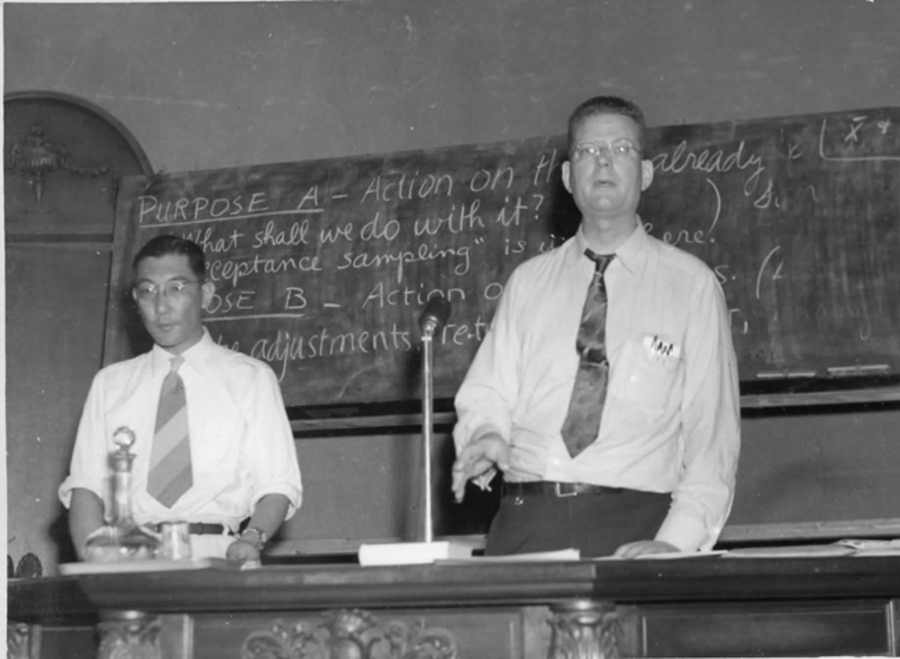
He applied the lesson from the war. He would teach the engineers, but he insisted on the executives too. Ichiro Ishikawa, who ran Japan's main business federation, arranged a dinner at the Industry Club in Tokyo in July 1950. Twenty-one men attended. Between them they ran most of the companies that mattered in Japan.
Deming drew a chain on the blackboard. Improve quality, and costs go down, because there's less rework, scrap, and delay. Productivity goes up. You win the market with better quality at a lower price. You stay in business and provide jobs. He told them if they did this, manufacturers around the world would be screaming for protection from Japanese goods within five years.
The executives were polite about it. It took four.
JUSE printed the transcripts of his lectures and offered him the royalties. He refused and told them to use the money for something useful. They used it to create the Deming Prize in 1951. Nissan won it in 1960, Toyota in 1965. By the time American television got around to asking what had happened, Japan had taken the American market in cars, steel, and consumer electronics, and Deming had been flying to Tokyo nearly every year for three decades. In 1960 the Emperor awarded him the Order of the Sacred Treasure. He was the first American to receive it.
At home during those same years, he taught statistics at NYU at night and consulted for the Census Bureau. Hardly anyone in American business knew who he was. He also composed church music in his spare time, including an arrangement of "The Star-Spangled Banner" written because he thought the original was too hard for a congregation to sing. He was that kind of person.
What happened at Ford
In 1980, Ford lost more money in a single year than any company in American history to that point. After the NBC broadcast, Ford executives invited Deming in to talk about quality. He talked about management instead. He told them roughly 85 percent of their problems came from the way the company was run and not from the people on the line. Some found that insulting. Donald Petersen, who became CEO in 1985, later said Deming had changed how he thought about the company. By 1986 Ford was the most profitable automaker in America, and the Taurus was the best-selling car in the country.
One story from that period explains his whole approach. Ford was building the same transmission in two places, at its own plant in Ohio and at Mazda in Japan, to identical specifications. Customers with the Mazda-built version had fewer warranty claims and said the car ran smoother. Ford engineers took both apart.
Every American part was within tolerance. So was every Japanese part. But the Japanese parts were clustered so tightly around the target dimension that some Ford engineers thought their measuring equipment had failed. Less variation meant the pieces fit better, the transmission ran quieter, and it lasted longer.
Both plants had followed the rules. One of them understood something the other didn't about the process itself. That was Deming's subject for forty years.
The line from a dinner in Tokyo to your sprint retrospective
If you build software, or run a company that does, you've been using Deming's ideas without knowing it. The line runs through Toyota, and every step is a translation, but it's a real line and you can trace it.
Toyota built its production system on what Deming taught in 1950. Taiichi Ohno added just-in-time, kanban, and the andon cord, but the management philosophy underneath, that problems live in the process and improvement runs in a loop, was Deming's. Every Toyota problem-solving form still has Plan, Do, Check, Act printed on it.
In 1988 an MIT researcher named John Krafcik gave the Toyota system an American name: Lean. Two years later The Machine That Changed the World made the word famous. Anything called Lean since then carries Deming by definition.
Agile came next. Jeff Sutherland has said Scrum came from a 1986 Harvard Business Review article on how Japanese companies developed products, and that Deming's loop was the model for the sprint. The retrospective is a Study step with the vocabulary changed. Mary and Tom Poppendieck drew the full line from Toyota to software in 2003.
Eric Ries named The Lean Startup after Toyota on purpose. Build-Measure-Learn is Deming's loop pointed at a product hypothesis instead of a factory process. Ries cites him by name.
DevOps is the newest branch. Gene Kim's Three Ways, flow, feedback, and continual learning, are Lean principles applied to shipping code, and Kim names Deming as a source. Deming's argument that departments optimizing themselves damage the whole is the entire case against dev and ops working as separate kingdoms.
Two honest footnotes. Joseph Juran went to Japan in 1954 and the Japanese credit him nearly as much. And Six Sigma, which Motorola and GE built in the 1980s and 90s, kept Deming's statistics and dropped his management philosophy, a point he made often and not politely. Most of the frameworks above did the reverse. They kept the loop and the systems view and let the statistics go. Several of them then reintroduced the quotas and rankings he spent forty years arguing against.
What he actually taught
His two books, Out of the Crisis and The New Economics, are dense and repetitive. The ideas underneath are not. Here is the part worth keeping.
Most of your problems are the system, not your people
Deming put the split at roughly 94 percent system, 6 percent individual. The system means the process, the tools, the inputs, the policies, the incentives, and the way information moves. Management designs all of that. So when results are bad, management owns most of the cause.
He proved it with a demonstration he ran in every seminar for years. A bucket holds 4,000 beads, 800 of them red. Volunteers from the audience scoop with a paddle that holds exactly 50. The company only sells white beads. Red beads are defects. He tells the workers the standard is three red beads or fewer and hands them a slogan.
Then he manages them the way most companies manage. He praises the low scorers and scolds the high scorers. He puts the worst one on probation. He offers a bonus. He launches a quality program. Eventually he fires the three worst and keeps the three best, and the three best immediately do worse.
Every worker averages about ten red beads per scoop, forever, because a fifth of the bucket is red. The one who scored five on day one wasn't skilled. The one who scored fifteen wasn't lazy. The bucket set the number. Every reward and punishment was noise, and some of it was harmful, because the people on probation started to believe they were the problem.
The only way to get fewer red beads is to change the bucket. And the workers can't change the bucket. Only management can.
Learn the difference between noise and a signal
Every process varies. Deming, following Shewhart, split variation into two kinds. Common cause is the built-in noise a stable process produces when nothing unusual is happening. Special cause is an identifiable event from outside: a new supplier, a machine that broke, a key person out sick.
The two require opposite responses. A special cause gets investigated and removed. Common cause gets left alone, or the whole process gets redesigned. What you don't do is react to each fluctuation as if it were a signal. Deming called that tampering, and he showed it makes a stable process worse.

The demonstration was a funnel dropping a marble onto a target. Leave the funnel alone and the marbles cluster tightly. Adjust it after every drop to correct the last miss and the scatter roughly doubles. Move it to wherever the last marble landed and it drifts off the table.

The manager who changes the sales quota every week based on last week's number is adjusting the funnel. So is the owner who calls an all-hands every time revenue dips.
Quality is the driver, not the cost
Most executives in 1950, in Japan and America, believed quality and cost traded off against each other. Deming's chain said the opposite. Poor quality is expensive because you pay for the work twice, once to do it wrong and once to fix it, plus whatever it costs when the customer leaves. Fixing the process removes that cost. Inspecting at the end doesn't, because by then the defect exists and you've already paid for it.
Ford's slogan in those years was "Quality Is Job 1." Deming would have hated it, because he thought slogans asked workers to do what the system wouldn't let them do. But the underlying idea was his, and Ford's numbers proved it.
Goals without a method are just pressure
This is the part of Deming that makes goal-oriented people uncomfortable, so it's worth getting right. Point 11 of his 14 Points for Management says to eliminate numerical quotas and management by objective. He called the annual performance review the most destructive of what he named the Seven Deadly Diseases of management.
He was not against targets. His Japanese students set aggressive ones. His objection was to a number handed down with nothing behind it but pressure. A quota without a method produces two things: gaming and fear. And fear was his real enemy, for a mechanical reason. Frightened people report what keeps them safe. An organization running on fear is running on bad data, and you cannot improve what you can't see accurately.
His line on it: "Whenever there is fear, you will get wrong figures."
Improve with a loop, not an initiative
Plan, Do, Study, Act. State a theory and predict what will happen. Test it small. Compare the result to the prediction and learn from the gap. Then adopt, adjust, or abandon.
He insisted on "Study" rather than "Check," which is how the Japanese had renamed it, because the point is learning from a prediction rather than grading an outcome. He meant many small loops running all the time, not one big annual improvement project. That loop is the thing every framework in the section above kept.
What this means for your company
You probably don't run a transmission plant. The bucket is still there.
Look at the process before you look at the person. When a number misses, the reflex is to find who dropped it. Ask instead what about the process made that result likely. If three different people in that seat would have produced roughly the same result, it's the seat.
Know your normal range before you react. For every number you look at weekly, know what a normal week looks like. Revenue that swings ten percent either way every week is telling you nothing new when it swings ten percent. A number that's been flat for a quarter is a process problem, which is yours to fix. Reacting to every data point is adjusting the funnel.
Attach a plan to every goal. A goal with an owner, a method, and a scheduled review is a test. A goal with a number and a deadline is a quota. Deming would object to the second and recognize the first as his own loop.
Find where you're paying twice. Somewhere in your business, work gets done and then redone. Rework, callbacks, refunds, the proposal that gets rewritten three times. That's where the money is going, and inspecting harder at the end won't get it back.
Make it safe to bring bad news. If the people on your team are afraid to report a problem, your numbers are already wrong and you don't know it yet.
If you build software, check what your framework kept and what it dropped. Scrum kept the loop. It also gave you velocity, and a velocity target is a quota with a nicer name. Lean Startup kept the loop and the small test. DevOps kept the systems view. None of them will stop you from ranking your engineers on story points, and Deming would tell you that's the Red Bead Experiment with a Jira board.
Deming never softened his central claim, and he said it to Japanese industrialists in 1950 and Ford executives in 1981 in the same words. If the results are bad, the system produced them. And the person who owns the system is the one reading this.