
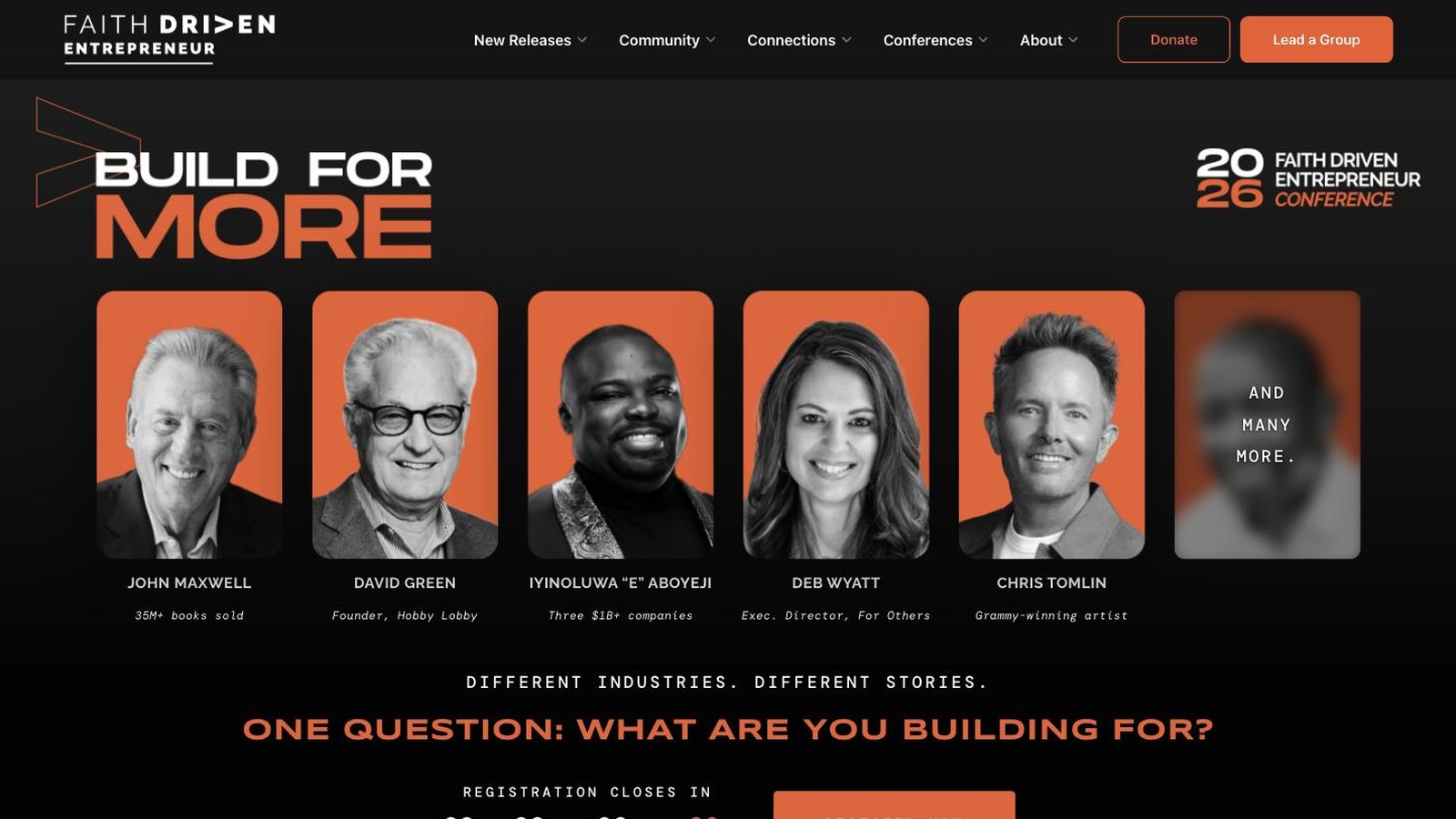
I watched this year's Faith Driven Entrepreneur Conference from a room full of other builders in New York City. Generous.Life hosted the watch party, and I showed up the way I have most years since I found this event: as someone who has built and sold things, and still can't fully answer the question the conference keeps asking. What are you building for?
I've hosted this same watch party myself in past years. I know what it takes to pull a room of entrepreneurs away from their inbox for a Friday morning livestream. This year I sat in the room and took notes while someone else ran it.
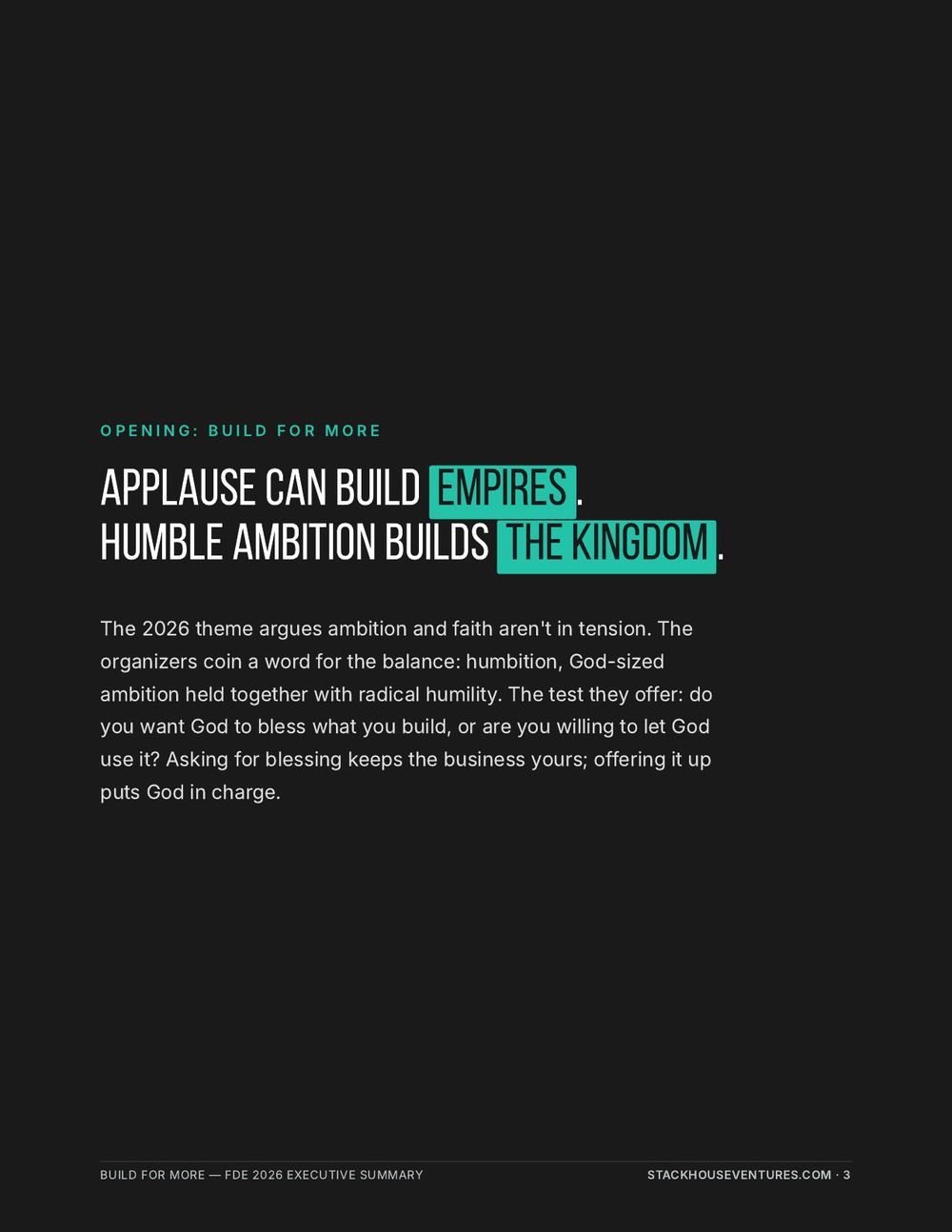
The Faith Driven Entrepreneur Conference runs as a live broadcast with local watch parties layered on top of it, in person, all over the world. This year's event drew roughly 10,000 attendees across more than 1,100 watch parties globally, up from 7,000 entrepreneurs and 600 watch parties the year before. This year's theme was Build for More, and the day opened with the line that set up everything after it: applause builds empires, humble ambition builds the kingdom.
If you want to find or start a watch party of your own next year, the conference page has everything you need. Generous.Life, the nonprofit that hosted the room I sat in, runs its own work year round connecting givers to high-impact causes across 4 cities, New York among them.

7 talks, one question
Every talk this year answered some version of the same question in a different market, industry, and country. Here's what stood out for the founders and builders in our own circle at Stackhouse.
Henry Kaestner: the movement
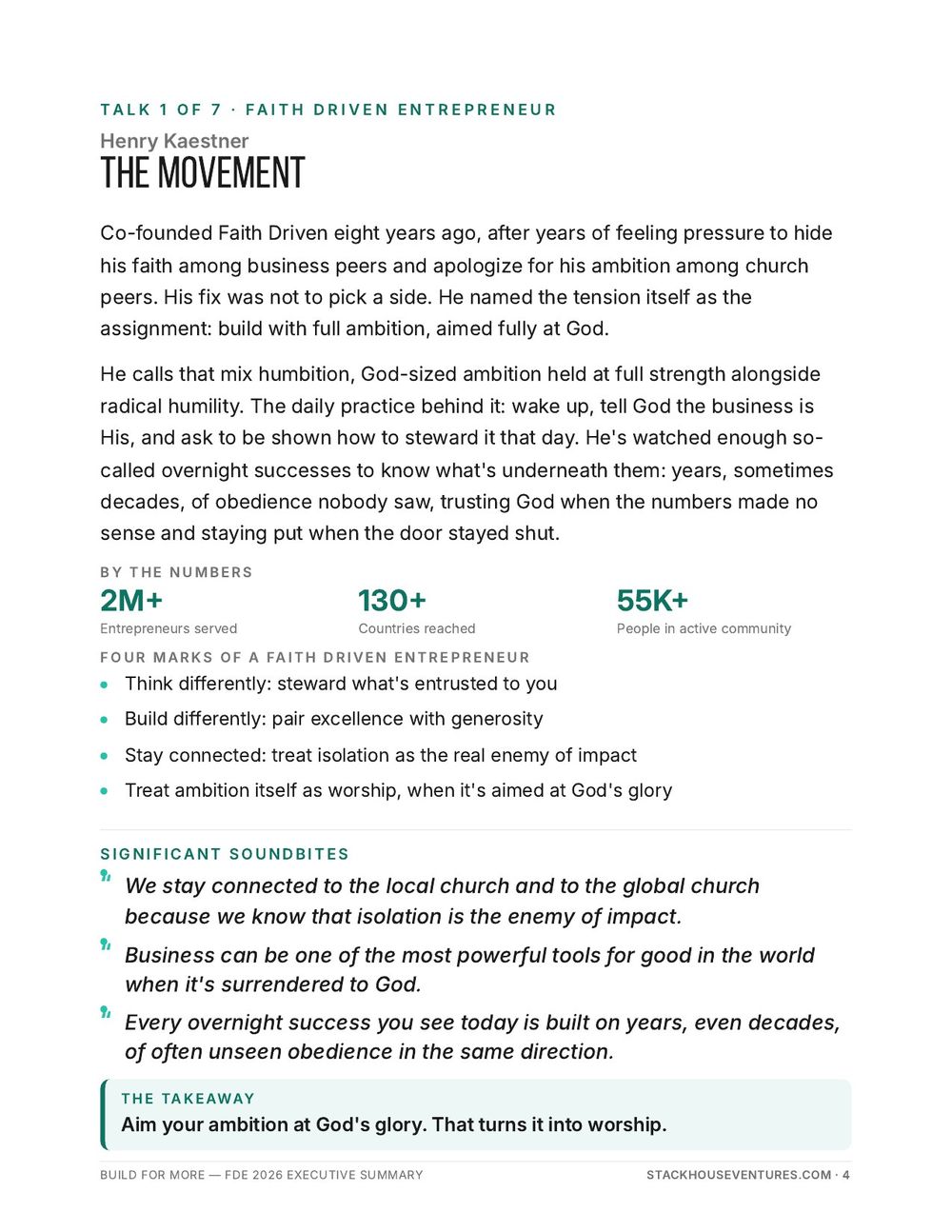
Henry Kaestner co-founded Faith Driven Entrepreneur 8 years ago, after years of hiding his faith among business peers and apologizing for his ambition among church peers. He named the tension itself as the job: build with full ambition, aimed fully at God. He calls the combination humbition, God-sized ambition held at full strength next to radical humility.
The practice behind it is one daily move: wake up, tell God the business is His, and ask to be shown how to steward it that day. Kaestner has watched enough so-called overnight successes to know what's underneath most of them. Years, sometimes decades, of obedience nobody saw.
Takeaway for founders: keep your ambition at full size, and give it an aim. Point it at something bigger than your own name on the door, and the size of it stops being a problem.
Richard Garnett: chocolate money
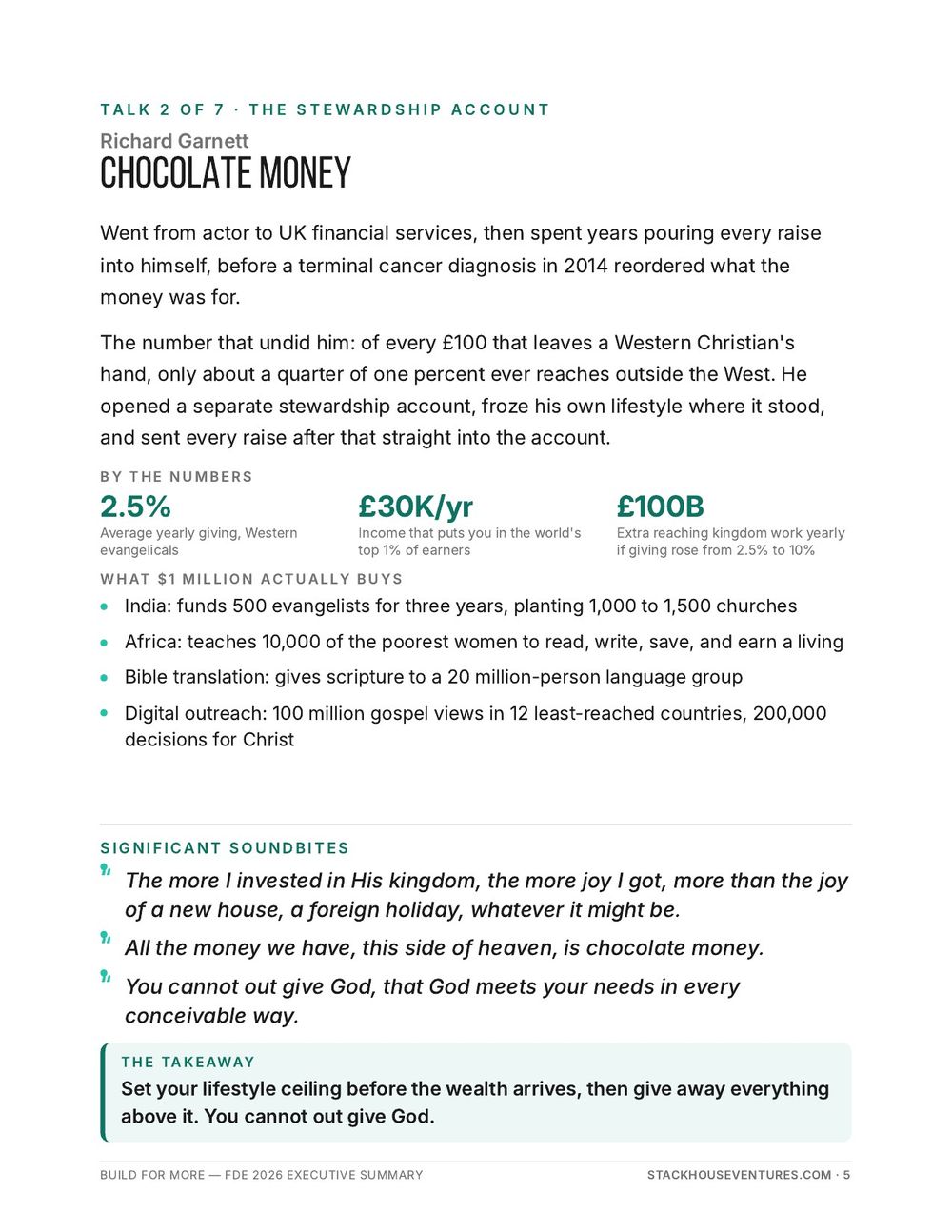
Richard Garnett went from acting to UK financial services, then spent years pouring every raise into himself. A terminal cancer diagnosis in 2014 reordered what the money was for. The number that undid him: of every 100 pounds that leaves a Western Christian's hand, roughly a quarter of one percent ever reaches outside the West.
Garnett opened a separate stewardship account, froze his own lifestyle where it stood, and sent every raise after that straight into the account. He calls all of it chocolate money, because none of us actually own any of it this side of heaven.
Takeaway for founders: set your lifestyle ceiling before the wealth arrives, while you're still sober about money and before a windfall clouds the math.
Iyinoluwa "E" Aboyeji: Learn2Earn
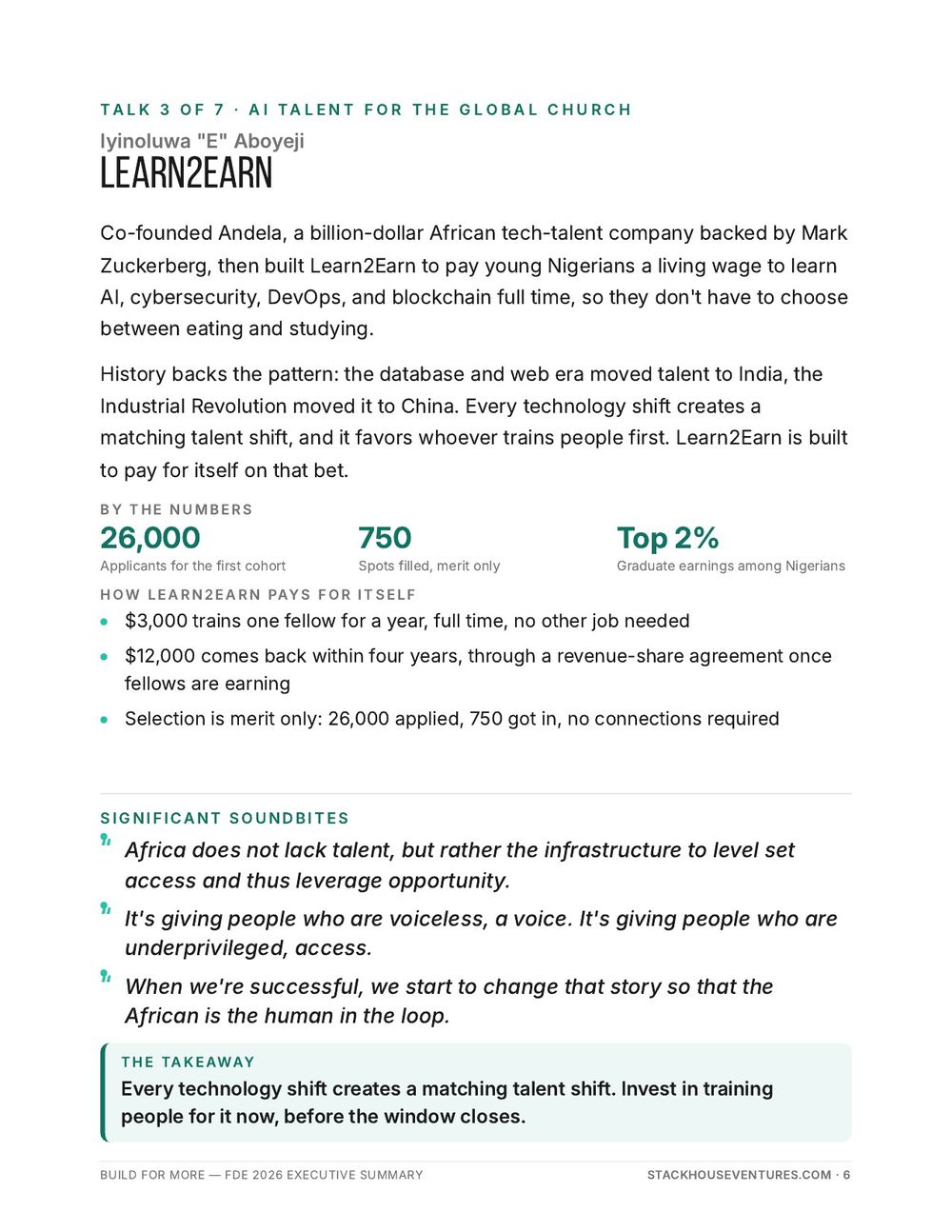
Iyinoluwa Aboyeji co-founded Andela, the billion-dollar African tech-talent company backed by Mark Zuckerberg, then built Learn2Earn to pay young Nigerians a living wage to learn AI, cybersecurity, DevOps, and blockchain full time. The bet behind it: every technology shift creates a matching talent shift, and it favors whoever trains people first. The database and web era moved talent to India. The Industrial Revolution moved it to China. Aboyeji is betting the AI era moves it to Africa, if the training happens now.
26,000 people applied for the first cohort. 750 got in, on merit alone. $3,000 trains one fellow for a year, and roughly $12,000 comes back within 4 years through a revenue-share agreement once fellows start earning.
Takeaway for founders: whatever shift you're watching happen in your own industry right now, the people who train talent for it first are the ones who end up owning the outcome.
John Maxwell: pick a number
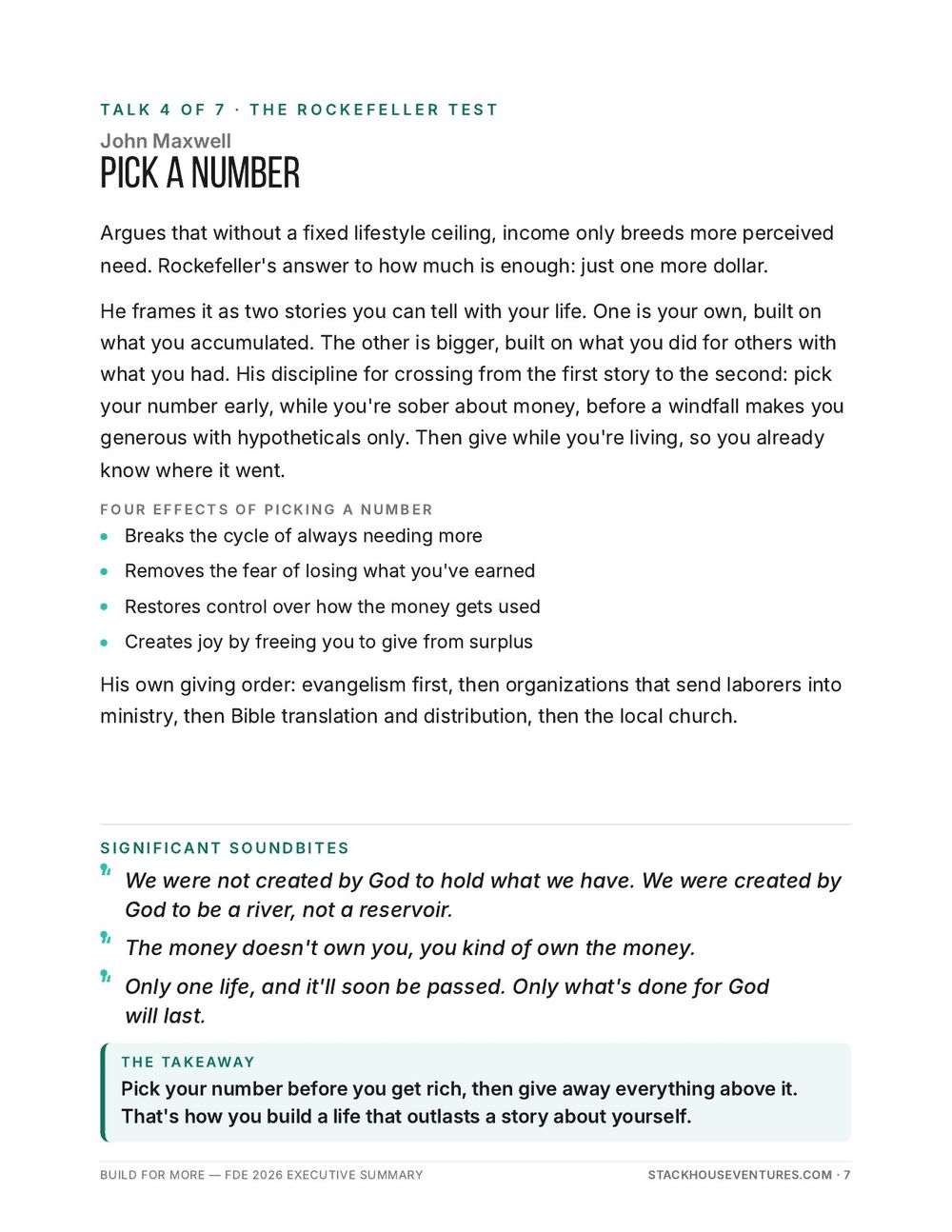
John Maxwell argued that without a fixed lifestyle ceiling, income only breeds more perceived need. He borrowed Rockefeller's answer to how much is enough: just one more dollar. Maxwell's frame is two stories you can tell with your life. One is your own, built on what you accumulated. The other is bigger, built on what you did for others with what you had.
His discipline for crossing from the first story into the second is to pick your number early, while you're still sober about money, before a windfall makes you generous with hypotheticals only. Then give while you're living, so you already know where it went.
Takeaway for founders: pick your number before you get rich. That single decision breaks the cycle of always needing more and hands you back control over what the money actually does.
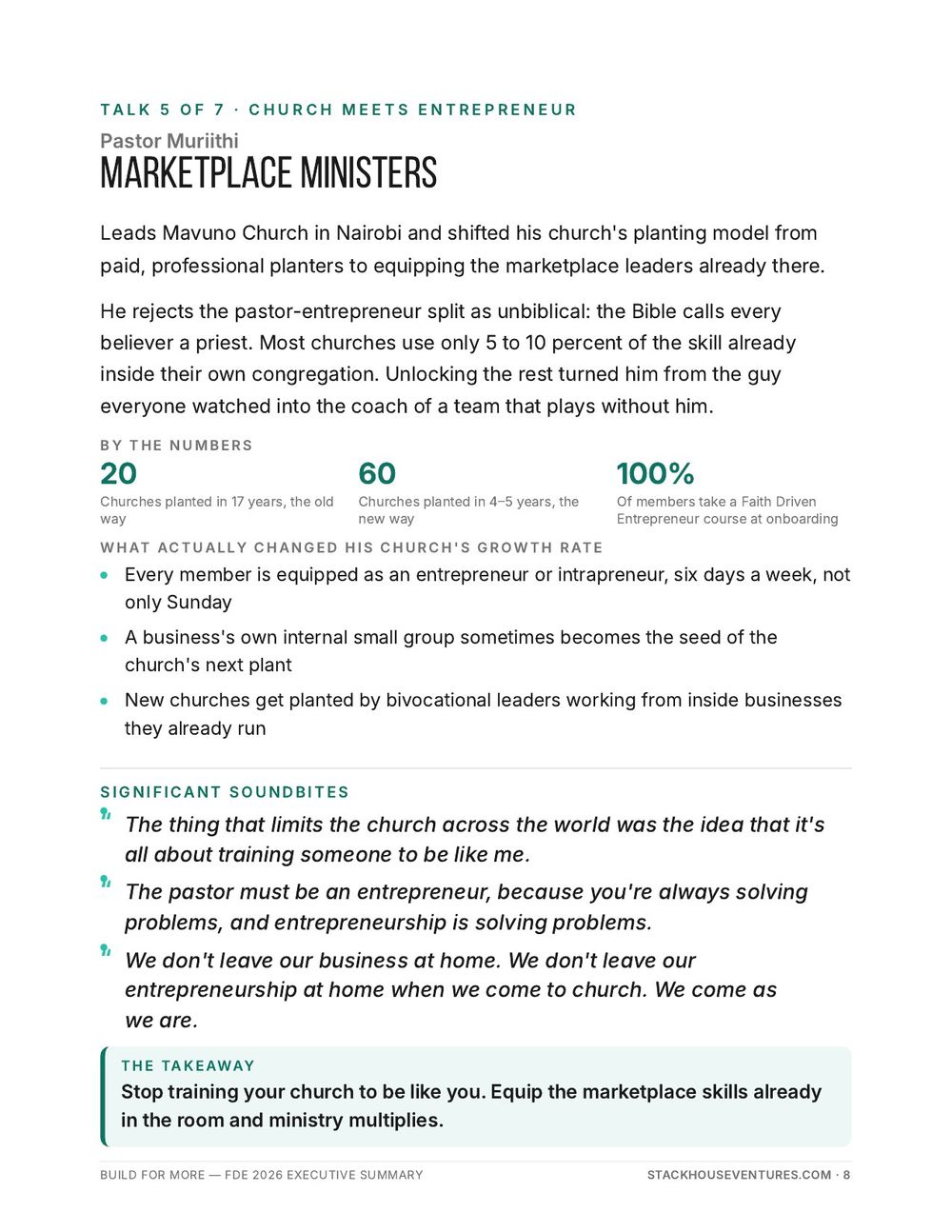
Pastor Muriithi Wanjau: marketplace ministers
Pastor Muriithi Wanjau leads Mavuno Church in Nairobi and shifted his church's planting model away from paid, professional planters and toward equipping the marketplace leaders already in his congregation. He rejects the split between pastor and entrepreneur as unbiblical. The Bible calls every believer a priest, and most churches use only 5 to 10 percent of the skill already inside their own congregation.
Unlocking the other 90 percent changed the math. Mavuno planted 20 churches in its first 17 years, the old way. It planted 60 more in the 4 to 5 years after the shift, mostly through bivocational leaders working from inside businesses they already ran.
Takeaway for founders: the skill inside your own team, church, or network right now is probably underused by a wide margin. Equip it, and the growth rate changes.
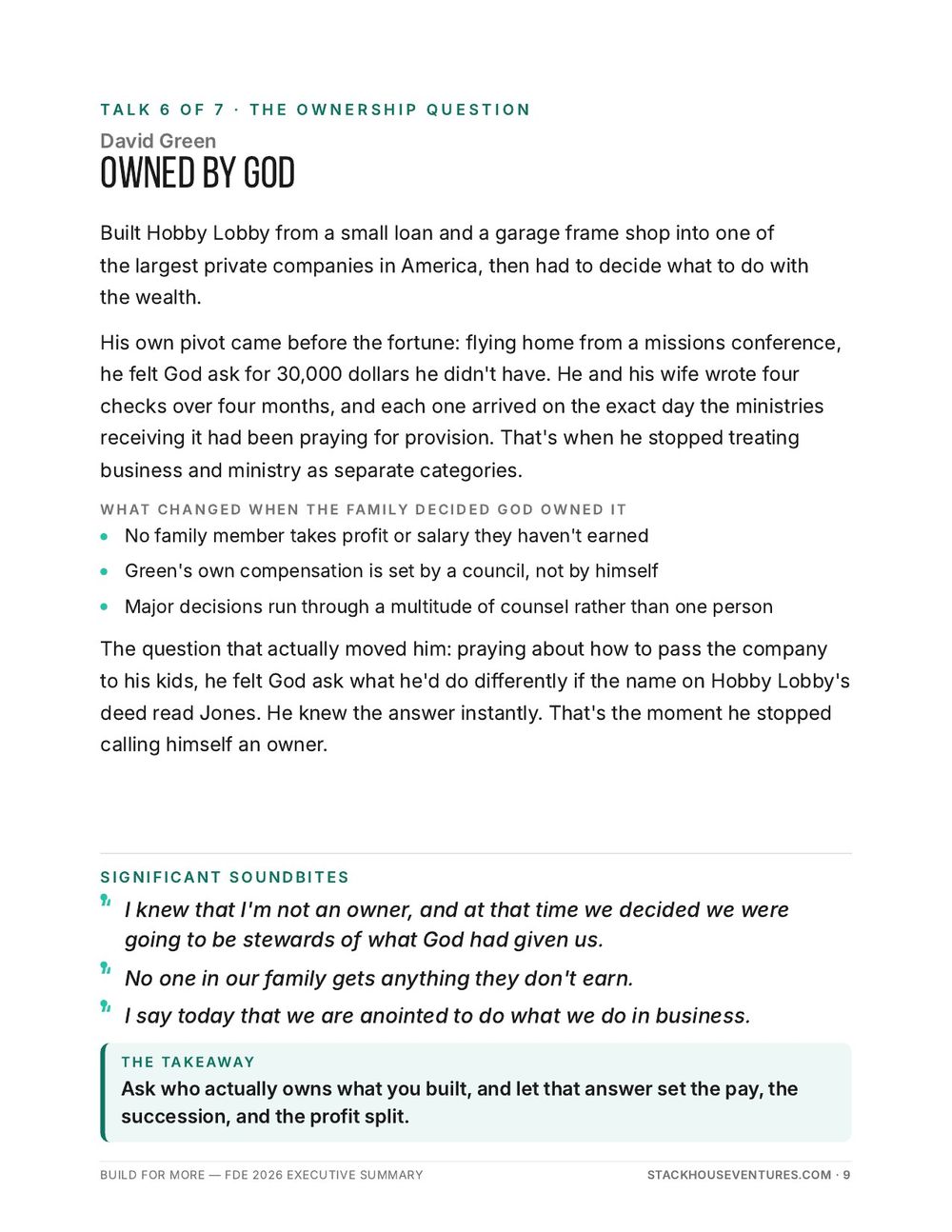
David Green: owned by God
David Green built Hobby Lobby from a small loan and a garage frame shop into one of the largest private companies in America, then had to decide what to do with the wealth. The pivot came before the fortune. Flying home from a missions conference, he felt God ask for $30,000 he didn't have. He and his wife wrote 4 checks over 4 months, and each one arrived on the exact day the ministries receiving it had been praying for provision.
Years later, praying about how to pass the company to his kids, Green asked God what to do with the wealth. The answer came back as a question: what would you do differently if the name on Hobby Lobby's deed read Jones? He knew the answer instantly, and that's the moment he stopped calling himself an owner. No family member at Hobby Lobby takes profit or salary they haven't earned. A council sets Green's own pay.
Takeaway for founders: ask who actually owns what you built. The answer changes your pay structure, your succession plan, and your profit split.
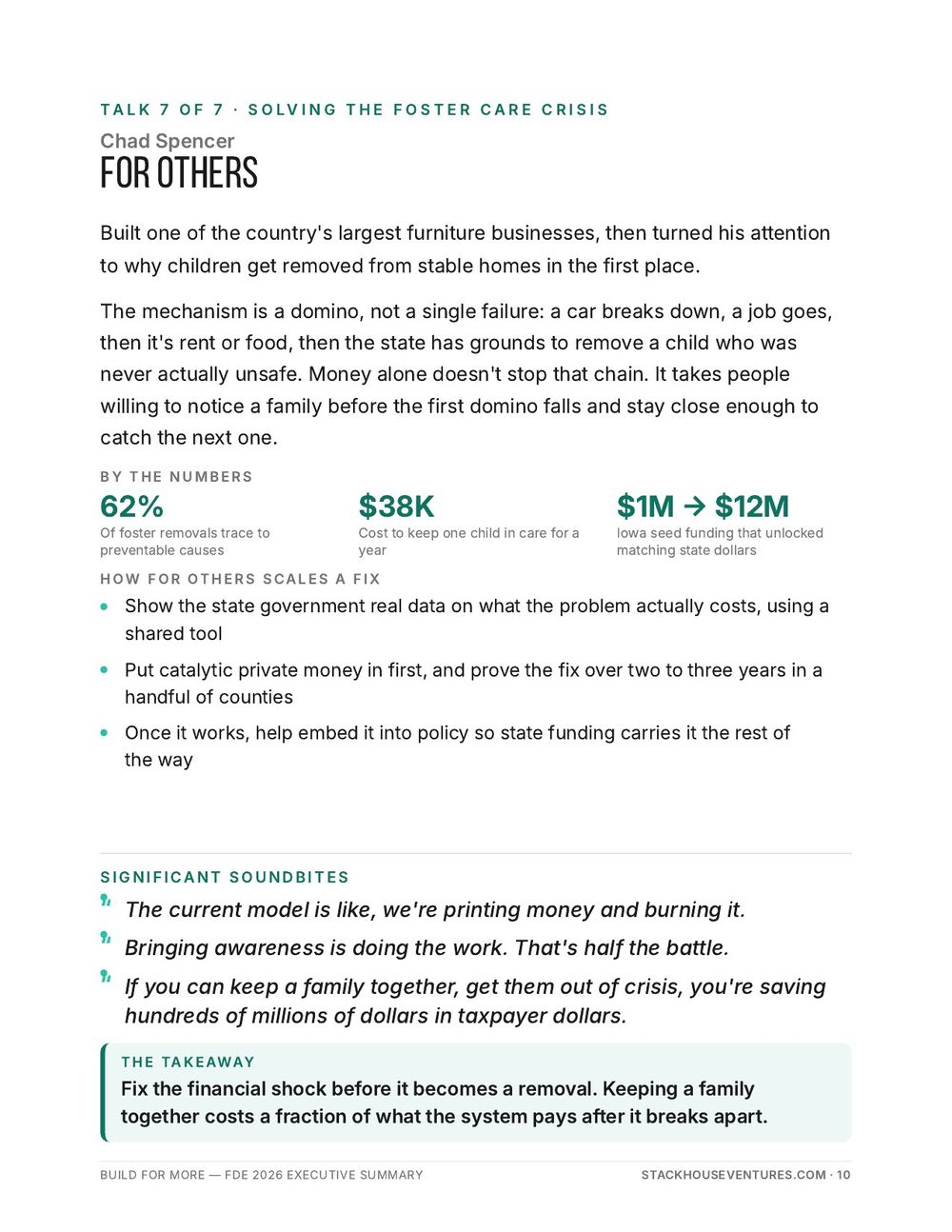
Chad Spencer: For Others
Chad Spencer built one of the country's largest furniture businesses, then turned his attention to why children get removed from stable homes in the first place. The mechanism works like a chain of dominoes: a car breaks down, a job goes, then it's rent or food, then the state has grounds to remove a child who was never actually unsafe. 62 percent of foster removals trace back to preventable causes like that one.
Spencer's organization, For Others, puts catalytic private money into a handful of counties first, proves the fix over 2 to 3 years, then works to get it embedded into state policy so public funding carries it the rest of the way. In Iowa, a million dollars of private seed funding unlocked $12 million in matching state funds.
Takeaway for founders: money fixes a broken system only when it's paired with people willing to notice a family before the first domino falls.
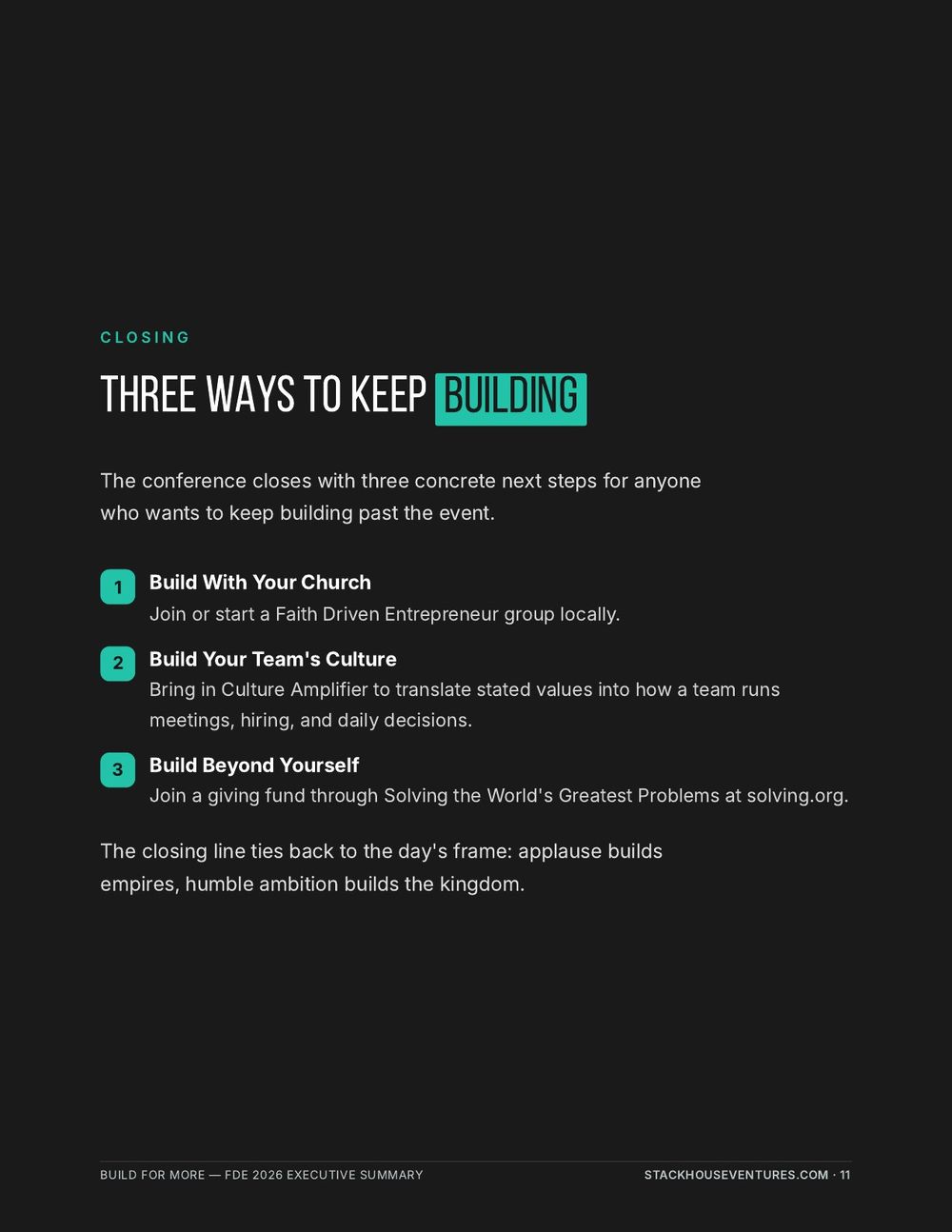
Applause builds empires
The conference closed on the same line it opened with: applause builds empires, humble ambition builds the kingdom. 7 different founders, 7 different industries, one repeated answer to what you're building for. Aim it somewhere past your own name.
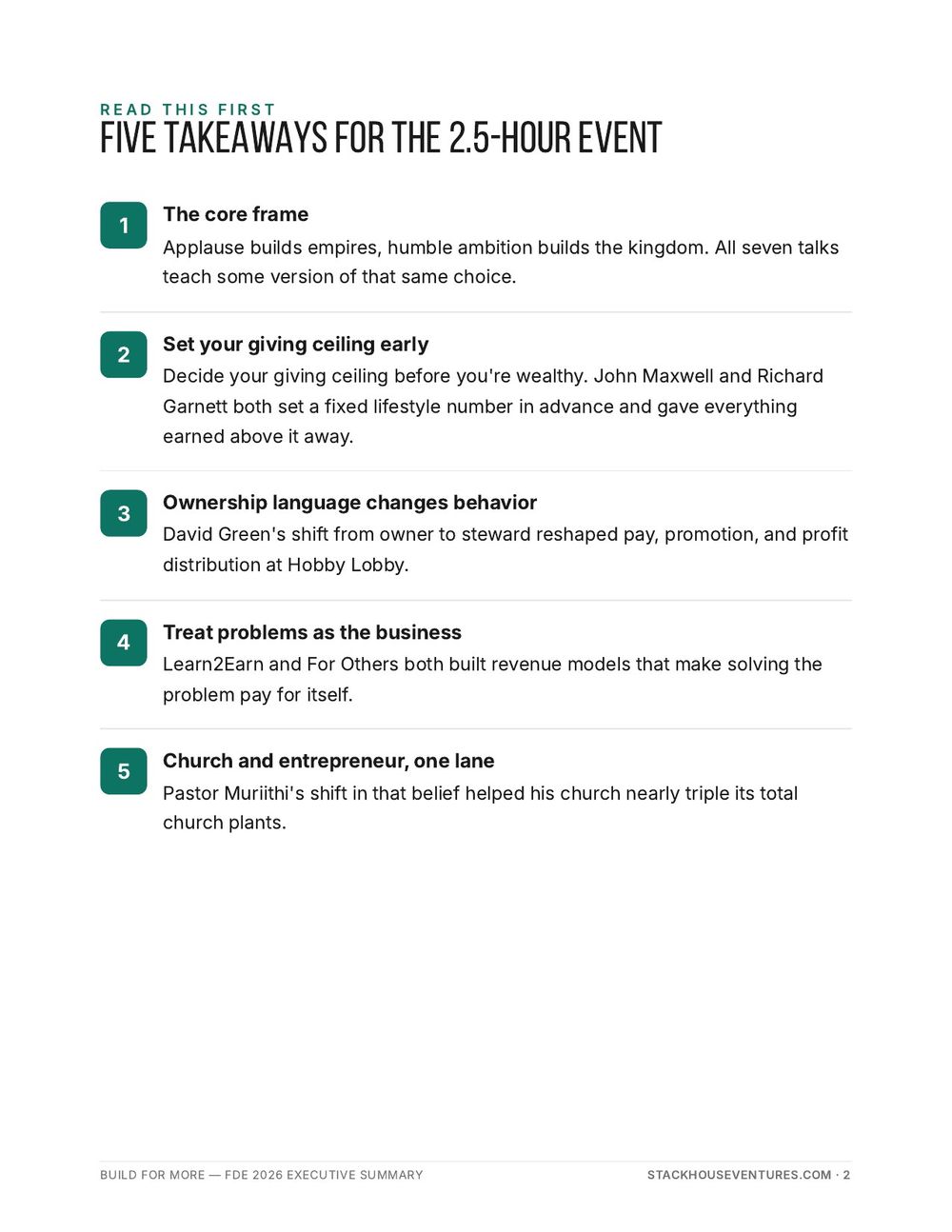
I turned my notes from this year's talks into a one-page executive summary you can download, print, and hand to your team or your mastermind group.
Flip through all 12 pages below, or download the PDF further down.
Free Download
Build for More: FDE 2026 Executive Summary
All 7 talks from this year's conference, distilled to one page each. Print it, or hand it to your team or your mastermind group.
Download the PDFIf you host a Faith Driven Entrepreneur watch party of your own, or you're thinking about starting one, the conference team has resources to make that simple. And if you want to see what Generous.Life does year round beyond one Friday in September, visit Generous.Life.